Some people really have an impact on the world. Maybe they discover the cure for a terrible disease, become great leaders of men and nations, or write fantastic books that are read and loved long after they themselves are gone.
Or maybe they help crush a nascent democracy and bring about an inhuman dictatorship that kills millions. Leon Trotsky is in this latter category.
Author Dimitri Volkogonov's career is interesting – a high official in the Soviet military and a loyal communist, he couldn't reconcile what he found in the historical archives with his ideological stance, so he renounced Communism. His severe criticism of Stalin, first in a biography, then in a WWII history, earned him enemies and he lost his high position within the military. He then went on to pen biographies of both Lenin and Trotsky. Leon Trotsky's career is also interesting, but for pretty much the opposite reasons. He jumps on Lenin's anti-democratic, dictatorship train at a time when Russia had the chance to solidify its democracy and then just digs deeper into the ideology he's chosen for himself (and, tragically, Russia). Even though the predictions he makes based on that ideology keep failing, he sticks with it – like his "Theory of Permanent Revolution", which led him to not only argue that the Communist revolution had to be spread to the rest of the world, but to keep predicting it, regardless of how that prediction kept on failing.
(It is interesting to note how Marxism tends to consider itself "scientific", and yet so many of its foremost proponents choose to disregard the fundamentals of science – like the idea that you need to take empirical outcomes into consideration and be prepared to adjust your theory accordingly.)
Trotsky was undoubtedly highly competent, not just as a theorist (and by the term "competent theorist" in the context of revolutionary Marxists, I refer not mainly to any actual deeper political insights, but to an ability to interpret and adjust the writings of Marx to make them seem to be applicable to the tactics the revolutionary movement wants to apply in any given political situation, and to do so in a manner that finds approval with the leaders of said revolutionary movement) but at actually making the revolution happen and survive – by holding speeches to fire the up masses, by building up an army making use of actually competent military men, regardless of whether they've served in the tsarist army before, and by waging utterly ruthless war on the revolutions enemies. (Note: the October Revolution was really more of a coup than a revolution, but I'll stick with established terminology and call it "the revolution".)
Anyway, much thanks to Trotsky's leadership of the army as People's Commissar of Army and Navy Affairs in the Russian Civil War (where the White forces certainly committed their unfair share of atrocities), the Bolsheviks were victorious. Unfortunately for Trotsky, he not only had to deal with the outright war against the White forces and the intervening Western armies; he also had to do bureaucratic battle, or turf war, with Stalin. That would not end with the war. Instead, due to a curious, seeming inability to fight a bureaucratic turf war – as well as a severe underestimation of Stalin – Trotsky was outmaneuvered and defeated, stripped of his position of power and even his Party membership, and exiled. This likely saved his life, as he thus was largely out of reach for Stalin's brutal reign of terror that would claim the lives of so many – including those relatives of Trotsky who remained in the USSR. On the other hand, in the long run, it wouldn't save his life at all, as a vengeful Stalin (all the more vengeful as Trotsky kept up a steady stream of criticism in the form of books and articles from his exile; you can find a huge archive of his writings here) ordered his security apparatus to have Trotsky killed. Meanwhile, a huge propaganda effort was also expended to blacken Trotsky's name as a capitalist lackey.
Finding refuge in Mexico after problematic stays in Turkey, France and Norway, Trotsky lived to see almost all of his relatives killed off by the vengeful Stalin and also experienced severe health problems. He seems to have gotten quite depressed – even contemplating suicide, but refraining from it because he didn't want to stain his legacy as a revolutionary, and possibly because he just didn't want to give Stalin the satisfaction. (That last part is my private speculation, not Volgokonov's.) Anyway, Stalin's murderers finally got to him in 1940. The end.
I read Robert Service's Lenin biography and found it rather dull, but I couldn't decide whether it was because of the way it was written, because I wasn't really in the mood to read it, or because Lenin simply was an incredibly dull person. You won't be bored in the company of Volgokonov's Trotsky, though; the only thing I was a bit put off by was the occasional somewhat repetitive editorializing, but I'll grant the author that right for his hard work not just bringing Trotsky's life history to light, but also overcoming his own personal history of being socialized into an inhuman state ideology.
Possibly what made the Lenin biography so boring was that he never really did anything worthwhile. He spent his life in exile mainly writing theoretical works of little scientific value or intellectual stringency, all the time building a case for revolution on whatever seemed the currently most likely theoretical basis for it. Then other people actually went through with a revolution, not according to his (somewhat variable) principles, so he rushed over there and ruined it. Then he died. The end. Trotsky, on the other hand, didn't just help Lenin and the other Bolsheviks wreck Russia, his military leadership was instrumental in keeping them in power, and he also experienced what he had put others through: the full force of the dictatorship's enmity. That makes him a more tragic and hence more interesting figure. It's hard to feel any grief over his death; he was all for murder and mayhem as long as he was part of the ruling "elite" dishing it out. His relatives, however, had no part in his crimes against the Russian people, so it's not hard to pity them their miserable fate – a fate in no small part due to Trotsky's hard work installing the regime that would kill them and consider itself justified in doing so.
This book paints a fascinating portrait of not only the man himself, but also of the anti-democratic ideology he helped make such an important part of the 20th century. So I'll end this review with a couple of illuminating quotes from Trotsky himself:
"From the historical point of view, European capitalism has run its course. It has not developed significantly productive forces. It has no further progressive role to play. It cannot open any new horizons. If this were not so, then any thought of the proletarian revolution in our age would be tilting at windmills (...) History is challenging the workers, as if it were saying to them: you must know that if you do not overthrow the bourgeoisie, you will perish beneath the ruins of civilization."
(Editorial comment: Yeah, right.)
"Violent revolution was necessary precisely because the urgent demands of history were powerless to cut a path for themselves through the apparatus of parliamentary democracy."
"The form of repression or its degree is of course not a question of principle. It is a pragmatic question"
(Editorial comment: Is it any wonder that a movement led by people like this would create a thoroughly inhuman, repressive and stagnant society? The greatest question raised by this book isn't what went wrong with Trotsky to make him the ruthless ideologue he became, but why on Earth some people – even today – would want to call themselves "Trotskyists".)
Recommended.
lördag 20 juli 2013
torsdag 27 juni 2013
Chester Brown: Paying for It. A Comic-Strip Memoir About Being a John
Chester Brown caused a bit of a (positive) stir with his rather anarchistic Ed the Happy Clown, which was, well, weird and disorganized and seemed to me a lot like Brown was letting out a lot of steam and pent-up emotions and frustrations. Whether that is correct or not, I of course don't know. Anyway, it certainly made him a household name in the alternative comics biz.
Paying for It is Brown's account of how his girlfriend drifted away from him, and he drifted into getting sex from prostitutes instead. The storytelling is not flashy, it's an eight-panels-per-page grid, separated in chapters where he tells the readers about his encounters with a particular prostitute, his musings about her and the whole prostitution thing, and his conversations with his friends about it. He does make the impression of being almost obsessively upfront about the whole thing, not just to his readers but to his friends as well.
And that makes it an interesting read, actually. Brown's initial fears about being robbed, his masturbation before encounters in order not to ejaculate too quickly, his debates with his friends on whether he's exploiting these women, his musings about the women he's with and his conversations with them... It sort of drags you in, partly because it concerns a subject that's a bit forbidden, secret and shameful to most of us – no, not sex; prostitution – partly because it's also sort of a dissection of Brown's own thinking and rationalizations. (Those rationalizations aren't always high-quality, I have to say.) He also finishes the book with an afterword with a more formal discussion of his pro-prostitution thoughts, which have a pretty strong libertarian slant.
Myself, I have a somewhat conflicted view of prostitution; we as a society have pretty much established that a woman's sexuality is her own, to do with as she pleases... except if she chooses to rent it out to a man for money. That is a bit of a double standard, in my opinion. On the other hand, I have no doubt that there's also a whole lot of exploitation going on in that business – like in a whole lot of other businesses, that's true, but somehow a business involving people's sexuality seems to get a lot closer to our cores as human beings, which makes it more problematic that just your employer screwing you out of your overtime money, as unacceptable as that is. And then comes that whole "forced into sex" angle, which includes selling your body not just because somebody's threatening and/or manipulating you, but also if you're doing it for the money you (and/or, perhaps, your family) need to get by, and trafficking, and… So I'm still not going to join Chester Brown in his defense of prostitution and the right to rent a person's body. Mind you, Brown's own account doesn't always help his case – like when he keeps on having sex with a girl even though she does seem to be in pain... Still, it's an interesting sneak peek into the mindset of a not entirely unlikable – but not exactly likable, either – john, and strangely compelling.
It's worth reading. It's also worth thinking about, and I would be interested in reading some non-slanted-either-way actual research on the issue – but not interested enough to actually go out of my way to look for that research, unfortunately, as my slate is currently pretty much sufficiently full as it is without adding that to it, thank you very much.
Anyway, recommended, for its honesty about Brown's own behavior and thoughts – but perhaps not for his own conclusions.
Paying for It is Brown's account of how his girlfriend drifted away from him, and he drifted into getting sex from prostitutes instead. The storytelling is not flashy, it's an eight-panels-per-page grid, separated in chapters where he tells the readers about his encounters with a particular prostitute, his musings about her and the whole prostitution thing, and his conversations with his friends about it. He does make the impression of being almost obsessively upfront about the whole thing, not just to his readers but to his friends as well.
And that makes it an interesting read, actually. Brown's initial fears about being robbed, his masturbation before encounters in order not to ejaculate too quickly, his debates with his friends on whether he's exploiting these women, his musings about the women he's with and his conversations with them... It sort of drags you in, partly because it concerns a subject that's a bit forbidden, secret and shameful to most of us – no, not sex; prostitution – partly because it's also sort of a dissection of Brown's own thinking and rationalizations. (Those rationalizations aren't always high-quality, I have to say.) He also finishes the book with an afterword with a more formal discussion of his pro-prostitution thoughts, which have a pretty strong libertarian slant.
![]() |
| Brown doesn't want to make unreasonable demands on the girls, and always tips. |
Myself, I have a somewhat conflicted view of prostitution; we as a society have pretty much established that a woman's sexuality is her own, to do with as she pleases... except if she chooses to rent it out to a man for money. That is a bit of a double standard, in my opinion. On the other hand, I have no doubt that there's also a whole lot of exploitation going on in that business – like in a whole lot of other businesses, that's true, but somehow a business involving people's sexuality seems to get a lot closer to our cores as human beings, which makes it more problematic that just your employer screwing you out of your overtime money, as unacceptable as that is. And then comes that whole "forced into sex" angle, which includes selling your body not just because somebody's threatening and/or manipulating you, but also if you're doing it for the money you (and/or, perhaps, your family) need to get by, and trafficking, and… So I'm still not going to join Chester Brown in his defense of prostitution and the right to rent a person's body. Mind you, Brown's own account doesn't always help his case – like when he keeps on having sex with a girl even though she does seem to be in pain... Still, it's an interesting sneak peek into the mindset of a not entirely unlikable – but not exactly likable, either – john, and strangely compelling.
![]() |
| Rationalizations. Turns out the girl doesn't even speak English. |
It's worth reading. It's also worth thinking about, and I would be interested in reading some non-slanted-either-way actual research on the issue – but not interested enough to actually go out of my way to look for that research, unfortunately, as my slate is currently pretty much sufficiently full as it is without adding that to it, thank you very much.
Anyway, recommended, for its honesty about Brown's own behavior and thoughts – but perhaps not for his own conclusions.
onsdag 19 juni 2013
François Schuiten & Benoît Peeters: Cities of the Fantastic: The Invisible Frontier, Vol 1 & 2
If you like gorgeous art, François Schuiten is your man. His soft colors and skillful rendering, especially of architecture and interiors, make Cities of the Fantastic: The Invisible Frontier (original title: Les Cités obscures: La Frontière invisible)very pleasing to the eye. I'm less impressed with the story, however... but we'll get to that momentarily.
Schuiten and script collaborator Benoît Peeters have published eleven albums in the Obscure Cities series, and these are albums 8 and 9. They tell the story of the young, freshly-minted cartographer Roland de Cremer arriving at the great cartography center of Sodrovno-Voldachie. At first, he's somewhat lost, not just having difficulties finding and entering the center, but also in finding his place there. He does learn the ropes of his job pretty soon, though, but exactly what that job is remains somewhat unclear to the reader. The end product of the center's work, however, seems to be to produce a pretty large-scale model of the country.
… But at the same time, new technology is making its entrance into the world of cartography. Another new arrival, Ismail Djunov, works with computers, the future of cartography, to hear him tell it. Roland's boss, "Mister Paul", is suspicious of the new technology and prefers the old, more craft-like, ways – and reminisces about the days when the cartography center was bustling with people and activity.
Ismail takes Roland to "the club", a place where cartographers can relax after a hard day's work, being waited upon by semi-clad young women who apparently also are supposed to have sex with any cartographer who so desires. Roland is smitten by one of the girls, Shkodra, and starts a relationship of sorts with her. It turns out that Shkodra has some sort of map-like markings on her lower back and buttocks, but they can't be clearly made out… Yet.
Then comes a visit from the leader of the country, Marshal Radisic, where he takes an interest in the cartography institute's work – because he needs the map to show that he is entitled to do what he's planning to do, attack and assimilate a neighboring country. Turns out the map that disproves his claims is exactly like the markings on Shkodra's bottom; and Roland realizes he has to do something to protect her...
I won't reveal more about the plot; it seems inspired by the tragedy of former Yugoslavia, and the story's clear distaste for expansionism and ruthless disregard for history and people in order to further one's political ambitions is something I think is shared by all decent people. I have a few problems with the story that prevents me from recommending the albums, though.
First of all, for me to enjoy science fiction, it generally needs to get the credibility right. The cartography center seems to be set right out in the desert, with no apparent means of getting food and other necessities to its occupants. Now, the setting is probably intended to reinforce the reader's experience of Roland's feelings of isolation and abandonment, but it detracts from the credibility of the story for me, undermining instead of enhancing it.
Second, I get somewhat annoyed with having those women like Shkodra put there to service the researchers sexually – it can be a valid part of the plot, intended to anger the reader at such exploitation, but that point is weakened by the way the women are depicted, beautiful and frequently in various stages of undress/nudity. IMO, Schuiten and Peeters are exploiting those women's bodies no less than their fictional characters do. (And notably, the beautiful Shkoda doesn't seem to have very much say in her own destiny no matter what; it's not like Roland, when he decides something needs to be done to protect her, doesn't pretty much decide what she should do for her.)
I also find the albums' depicted conflict between modern methods and Mister Paul's more craftmanship-oriented approach to be a false dichotomy. Of course really old maps are cool, but there's no need to romanticize them – modern maps, done digitally, are far more accurate and informative. This goes beyond cartography, of course – which in this case is to a large extent a metaphor, anyway, if I understand the albums correctly.
Finally, while Schuiten is a great artist for depicting environments and the human body (both dressed and undressed, his faces are usually not very expressive – though as it adds to the perceived slowness of the storytelling, perhaps it is intentional.
So, a couple of beautiful books, but in the end not for me. I'll probably read the rest of the albums in the series when I get across them, but I won't be actively seeking them out.
Schuiten and script collaborator Benoît Peeters have published eleven albums in the Obscure Cities series, and these are albums 8 and 9. They tell the story of the young, freshly-minted cartographer Roland de Cremer arriving at the great cartography center of Sodrovno-Voldachie. At first, he's somewhat lost, not just having difficulties finding and entering the center, but also in finding his place there. He does learn the ropes of his job pretty soon, though, but exactly what that job is remains somewhat unclear to the reader. The end product of the center's work, however, seems to be to produce a pretty large-scale model of the country.
… But at the same time, new technology is making its entrance into the world of cartography. Another new arrival, Ismail Djunov, works with computers, the future of cartography, to hear him tell it. Roland's boss, "Mister Paul", is suspicious of the new technology and prefers the old, more craft-like, ways – and reminisces about the days when the cartography center was bustling with people and activity.
Ismail takes Roland to "the club", a place where cartographers can relax after a hard day's work, being waited upon by semi-clad young women who apparently also are supposed to have sex with any cartographer who so desires. Roland is smitten by one of the girls, Shkodra, and starts a relationship of sorts with her. It turns out that Shkodra has some sort of map-like markings on her lower back and buttocks, but they can't be clearly made out… Yet.
Then comes a visit from the leader of the country, Marshal Radisic, where he takes an interest in the cartography institute's work – because he needs the map to show that he is entitled to do what he's planning to do, attack and assimilate a neighboring country. Turns out the map that disproves his claims is exactly like the markings on Shkodra's bottom; and Roland realizes he has to do something to protect her...
I won't reveal more about the plot; it seems inspired by the tragedy of former Yugoslavia, and the story's clear distaste for expansionism and ruthless disregard for history and people in order to further one's political ambitions is something I think is shared by all decent people. I have a few problems with the story that prevents me from recommending the albums, though.
First of all, for me to enjoy science fiction, it generally needs to get the credibility right. The cartography center seems to be set right out in the desert, with no apparent means of getting food and other necessities to its occupants. Now, the setting is probably intended to reinforce the reader's experience of Roland's feelings of isolation and abandonment, but it detracts from the credibility of the story for me, undermining instead of enhancing it.
Second, I get somewhat annoyed with having those women like Shkodra put there to service the researchers sexually – it can be a valid part of the plot, intended to anger the reader at such exploitation, but that point is weakened by the way the women are depicted, beautiful and frequently in various stages of undress/nudity. IMO, Schuiten and Peeters are exploiting those women's bodies no less than their fictional characters do. (And notably, the beautiful Shkoda doesn't seem to have very much say in her own destiny no matter what; it's not like Roland, when he decides something needs to be done to protect her, doesn't pretty much decide what she should do for her.)
I also find the albums' depicted conflict between modern methods and Mister Paul's more craftmanship-oriented approach to be a false dichotomy. Of course really old maps are cool, but there's no need to romanticize them – modern maps, done digitally, are far more accurate and informative. This goes beyond cartography, of course – which in this case is to a large extent a metaphor, anyway, if I understand the albums correctly.
Finally, while Schuiten is a great artist for depicting environments and the human body (both dressed and undressed, his faces are usually not very expressive – though as it adds to the perceived slowness of the storytelling, perhaps it is intentional.
So, a couple of beautiful books, but in the end not for me. I'll probably read the rest of the albums in the series when I get across them, but I won't be actively seeking them out.
tisdag 18 juni 2013
Tom DeFalco: Comics Creators On Fantastic Four & Comics Creators On Spider-Man
In the late eighties-early nineties, I was getting more and more disillusioned with Marvel Comics. The stories were sort of losing heart, and an increased output of books was accompanied with what seemed to be laxer standards for writing as well as art.
Well, perhaps "laxer standards" isn't the right word for it – there seemed to be tighter editorial reins than in the seventies, which were sort of a golden age for the company in my opinion. I wasn't old enough to get and read the books until the late last couple of years of the decade, when I started ordering back issues from a couple of Swedish collectors and traders and got lots of old comic books delivered home via mail (to my delight and my mother's consternation), but digging into those piles of comics by the likes of Gene Colan, Roger Stern, Frank Miller, Jim Shooter (who wrote some great Avengers stories IMO – I still have fond memories of one where there are so many flightless Avengers that they have to commandeer a bus to take them to the final confrontation with a cosmic enemy hiding out in the suburbs), Steve Englehart and Steve Gerber. Let me just repeat the (to me) most important name of those: Steve Gerber.
Steve Gerber was one of those writers who could be used to define the term "offbeat". He wrote stories not quite like anybody else's, stories about outsidership that emphasized the characters, not the action. They were brilliant – and usually flawed, but still brilliant. Think a seventies Grant Morrison. Or, for that matter, a seventies J. M. DeMatteis, a writer who exploded on the scene in the eighties. (Well, OK, he didn't really explode on the scene, I don't think he had a sufficiently huge mainstream impact for that, but he did for me. I loved his stories, with their flawed protagonists and the forgiving, even loving, perspective he had on those flawed people.)
Anyway, Gerber not only created Howard the Duck and wrote some absolutely terrific stories about this duck trapped on a world not his own (not that his own world was ever really his own, either, but I digress), he also wrote stories that told the reader that you could never be entirely certain about anything, in the Marvel universe or, by extension, in your own universe.
And that characterized the seventies Marvel universe for me. Gerber was just the creator who was most explicit about it.
We talk about the "revisionist" comics creators revitalizing the DC universe in the eighties-onwards – the "British invasion", Alan Moore, Neil Gaiman, to a certain extent Alan Grant, Grant Morrison, etc. But we tend to forget that "revisionism", or rather, "chucking everything out the window and starting anew" was not uncommon in the seventies Marvel universe. "Hey, all those memories you have about your youth and origin? They're false, implanted under hypnosis by the Red Skull" wasn't quite the order of the day, but it wasn't uncommon for new writers to drastically remake characters and storylines (and introducing some pretty outrageous stuff like having President Nixon being the head of a plot to enslave America and killing himself when defeated by Cap). This made for a somewhat unstable but very interesting universe. With greater editorial control came a better ability to make deadlines and a more coherent Marvel universe, but also a somewhat less interesting one.
And then came the real downturn. Titles were turned over to people who knew how to tell stories that sold, but who didn't know how to tell stories with real heart in them (and in some cases didn't even seem to know how to write). The art went similarly downhill; competent artists cranking out so many pages that they simply didn't have time to do a proper job, or doing breakdowns turned into final art by inkers who weren't able to provide the magic that full, beautiful pencils can create, new artist being brought in that weren't up to scratch – not everybody can be a John Buscema, or a Gene Colan, or a Mike Zeck, but when you've been spoiled by reading their stuff, you won't be happy with art that just isn't up to snuff.
I'll refrain from naming any names here, as it wouldn't serve any real purpose; suffice to say, I wasn't happy with the art on quite a few of my former favorite titles. I'll give you an example, though: Captain America. After a brief but beautiful run on the title by Roger Stern, John Byrne and Joe Rubinstein – top-notch creators all – the book was taken over by J. M. DeMatteis and Mike Zeck (I don't quite remember the inker, but it may have been Bob McLeod). Now, this was a move from an excellent creative team to another excellent creative team. DeMatteis crafted stories of subtlety, love, drama and melodrama, and the art was beautiful and action-packed. In fact, my favorite Cap moment occurred during this run – a monster has kidnapped Cap's girlfriend Bernie, and Cap comes to rescue her. The monster promptly beats him to a pulp. As the monster prepares to kill Cap, Bernie (who has made quite an impression on the monster) tries to stop him. This makes the monster stop, and think, and he decides that maybe Cap isn't his enemy at all. The monster takes off in order to sit on a mountaintop to think things through properly as Bernie cradles the unconscious Cap's head in her lap. Cap slowly wakes up, and wearily looks up to see Bernie's face, saying:
"Bernie… Are you okay…?"
That scene, more than any other, defines Captain America – and Steve Rogers – for me.
DeMatteis then proceeded to, among other things, tell a multiple-issue story about Cap's gay childhood friend, who protected him from bullies, contacting him again after all these years. (This was way before gay was considered OK in mainstream comics, movies and television.) And then he was replaced by a writer who was more interested in telling stories about terrorists and cleaning up Marvel continuity by having some dark menace kill off marginal Marvel crooks, and who completely lacked DeMatteis' subtle and deeply humanistic sensitivities, as well as his dramatic flair as a writer. The art chores were handled by an artist who similarly lacked subtleness and elegance. The book just died to me.
The same happened to many other Marvel books during what I think may have been called the "Marvel explosion". Writers were brought in who wrote stories superficially dramatic, but lacking all subtlety, and coordinating a lot of titles became more important than actually producing interesting stories with depth. By the early nineties, Marvel was pretty much a mess. DC wasn't a whole lot better, either; Frank Miller had ruined Batman with his brilliant Dark Knight Returns and Year One – his violent, driven Batman was so exceedingly well done and popular that it infected all the Batman stories produced by DC… and those other writers generall weren't good enough to do Miller's Batman without turning him into merely another monomaniacal and brutal action hero. (In fact, even Miller himself wasn't, as shown by his follow-up, The Dark Knight Strikes Again.)
Anyway, that was a pretty long-winded run-up to Tom DeFalco's excellent interview books Comics Creators On Fantastic Four and Comics Creators On Spider-Man, but the reason for it is that I hold DeFalco and several of his interviewees to be among those responsible for Marvel's downhill slide, both as writers and editors. But nevertheless, it's very interesting to read their takes on the characters who have very much defined the Marvel universe, the Fantastic Four and Peter Parker/Spider-Man. Also, DeFalco turns out to be a very good interviewer, asking about the creators' backgrounds, how they got into comics and how they view the characters and the creative process. You also get some interesting snapshots of how Marvel worked in the early days, as well as later on.
All in all, this is very interesting reading but hard to summarize as the creators involved (not just writers but also artists) have such diverse views. Many want to go back to the characters' roots, but they don't always agree on what those roots are. For instance, going back the Lee-Kirby roots of the FF doesn't necessarily mean using their old villains, because they were all about creating new ones, and thus "going back to the roots" could also mean doing just that, expanding the vistas explored as well as the villains roster. (Mark Waid, one of the better writers in the business, makes that point rather explicitly. I found that slightly ironic as I remembered reading his and Carlos Pacheco's Resurrection of Galactus story, and halfway through it realizing why I thought it was merely a decent story but not a great one even though it was so well told: I'd read basically the same story by Lee & Kirby, if not quite so expertly crafted. Just to be on the safe side, I searched that book out in my collection – fortunately, as it turns out, because Waid had nothing to do with it. Never trust your memory.)
Everybody also seems to agree that Fantastic Four is about family, with the exploration theme also being mentioned by several creators.
For Spider-Man, I thought Paul Jenkins had the most interesting take on the character – Peter is a hero because he cares enough to keep fighting, unlike the villains who've chosen to take the easier, lesser path instead. (And if you doubt that that is true, go buy Kraven's Last Hunt by DeMatteis-Zeck-McLeod, arguably the best Spider-Man tale ever told.)
Finally, a partial roster of the creators interviewed: Stan Lee, Brian Michael Bendis, J. M. DeMatteis, Todd McFarlane, John Romita, Gerry Conway, Roger Stern, Marv Wolfman, Len Wein, John Byrne, Howard Mackie, Ralph Macchio, Walter Simonson, Doug Moench, Joe Sinnot and Jim Lee. Some really big names in there.
Highly recommended.
(Note to Swedish readers: I borrowed these books from the Serieteket library in Stockholm, a great resource for comics lovers.)
Well, perhaps "laxer standards" isn't the right word for it – there seemed to be tighter editorial reins than in the seventies, which were sort of a golden age for the company in my opinion. I wasn't old enough to get and read the books until the late last couple of years of the decade, when I started ordering back issues from a couple of Swedish collectors and traders and got lots of old comic books delivered home via mail (to my delight and my mother's consternation), but digging into those piles of comics by the likes of Gene Colan, Roger Stern, Frank Miller, Jim Shooter (who wrote some great Avengers stories IMO – I still have fond memories of one where there are so many flightless Avengers that they have to commandeer a bus to take them to the final confrontation with a cosmic enemy hiding out in the suburbs), Steve Englehart and Steve Gerber. Let me just repeat the (to me) most important name of those: Steve Gerber.
Steve Gerber was one of those writers who could be used to define the term "offbeat". He wrote stories not quite like anybody else's, stories about outsidership that emphasized the characters, not the action. They were brilliant – and usually flawed, but still brilliant. Think a seventies Grant Morrison. Or, for that matter, a seventies J. M. DeMatteis, a writer who exploded on the scene in the eighties. (Well, OK, he didn't really explode on the scene, I don't think he had a sufficiently huge mainstream impact for that, but he did for me. I loved his stories, with their flawed protagonists and the forgiving, even loving, perspective he had on those flawed people.)
Anyway, Gerber not only created Howard the Duck and wrote some absolutely terrific stories about this duck trapped on a world not his own (not that his own world was ever really his own, either, but I digress), he also wrote stories that told the reader that you could never be entirely certain about anything, in the Marvel universe or, by extension, in your own universe.
And that characterized the seventies Marvel universe for me. Gerber was just the creator who was most explicit about it.
We talk about the "revisionist" comics creators revitalizing the DC universe in the eighties-onwards – the "British invasion", Alan Moore, Neil Gaiman, to a certain extent Alan Grant, Grant Morrison, etc. But we tend to forget that "revisionism", or rather, "chucking everything out the window and starting anew" was not uncommon in the seventies Marvel universe. "Hey, all those memories you have about your youth and origin? They're false, implanted under hypnosis by the Red Skull" wasn't quite the order of the day, but it wasn't uncommon for new writers to drastically remake characters and storylines (and introducing some pretty outrageous stuff like having President Nixon being the head of a plot to enslave America and killing himself when defeated by Cap). This made for a somewhat unstable but very interesting universe. With greater editorial control came a better ability to make deadlines and a more coherent Marvel universe, but also a somewhat less interesting one.
And then came the real downturn. Titles were turned over to people who knew how to tell stories that sold, but who didn't know how to tell stories with real heart in them (and in some cases didn't even seem to know how to write). The art went similarly downhill; competent artists cranking out so many pages that they simply didn't have time to do a proper job, or doing breakdowns turned into final art by inkers who weren't able to provide the magic that full, beautiful pencils can create, new artist being brought in that weren't up to scratch – not everybody can be a John Buscema, or a Gene Colan, or a Mike Zeck, but when you've been spoiled by reading their stuff, you won't be happy with art that just isn't up to snuff.
I'll refrain from naming any names here, as it wouldn't serve any real purpose; suffice to say, I wasn't happy with the art on quite a few of my former favorite titles. I'll give you an example, though: Captain America. After a brief but beautiful run on the title by Roger Stern, John Byrne and Joe Rubinstein – top-notch creators all – the book was taken over by J. M. DeMatteis and Mike Zeck (I don't quite remember the inker, but it may have been Bob McLeod). Now, this was a move from an excellent creative team to another excellent creative team. DeMatteis crafted stories of subtlety, love, drama and melodrama, and the art was beautiful and action-packed. In fact, my favorite Cap moment occurred during this run – a monster has kidnapped Cap's girlfriend Bernie, and Cap comes to rescue her. The monster promptly beats him to a pulp. As the monster prepares to kill Cap, Bernie (who has made quite an impression on the monster) tries to stop him. This makes the monster stop, and think, and he decides that maybe Cap isn't his enemy at all. The monster takes off in order to sit on a mountaintop to think things through properly as Bernie cradles the unconscious Cap's head in her lap. Cap slowly wakes up, and wearily looks up to see Bernie's face, saying:
"Bernie… Are you okay…?"
That scene, more than any other, defines Captain America – and Steve Rogers – for me.
DeMatteis then proceeded to, among other things, tell a multiple-issue story about Cap's gay childhood friend, who protected him from bullies, contacting him again after all these years. (This was way before gay was considered OK in mainstream comics, movies and television.) And then he was replaced by a writer who was more interested in telling stories about terrorists and cleaning up Marvel continuity by having some dark menace kill off marginal Marvel crooks, and who completely lacked DeMatteis' subtle and deeply humanistic sensitivities, as well as his dramatic flair as a writer. The art chores were handled by an artist who similarly lacked subtleness and elegance. The book just died to me.
The same happened to many other Marvel books during what I think may have been called the "Marvel explosion". Writers were brought in who wrote stories superficially dramatic, but lacking all subtlety, and coordinating a lot of titles became more important than actually producing interesting stories with depth. By the early nineties, Marvel was pretty much a mess. DC wasn't a whole lot better, either; Frank Miller had ruined Batman with his brilliant Dark Knight Returns and Year One – his violent, driven Batman was so exceedingly well done and popular that it infected all the Batman stories produced by DC… and those other writers generall weren't good enough to do Miller's Batman without turning him into merely another monomaniacal and brutal action hero. (In fact, even Miller himself wasn't, as shown by his follow-up, The Dark Knight Strikes Again.)
Anyway, that was a pretty long-winded run-up to Tom DeFalco's excellent interview books Comics Creators On Fantastic Four and Comics Creators On Spider-Man, but the reason for it is that I hold DeFalco and several of his interviewees to be among those responsible for Marvel's downhill slide, both as writers and editors. But nevertheless, it's very interesting to read their takes on the characters who have very much defined the Marvel universe, the Fantastic Four and Peter Parker/Spider-Man. Also, DeFalco turns out to be a very good interviewer, asking about the creators' backgrounds, how they got into comics and how they view the characters and the creative process. You also get some interesting snapshots of how Marvel worked in the early days, as well as later on.
All in all, this is very interesting reading but hard to summarize as the creators involved (not just writers but also artists) have such diverse views. Many want to go back to the characters' roots, but they don't always agree on what those roots are. For instance, going back the Lee-Kirby roots of the FF doesn't necessarily mean using their old villains, because they were all about creating new ones, and thus "going back to the roots" could also mean doing just that, expanding the vistas explored as well as the villains roster. (Mark Waid, one of the better writers in the business, makes that point rather explicitly. I found that slightly ironic as I remembered reading his and Carlos Pacheco's Resurrection of Galactus story, and halfway through it realizing why I thought it was merely a decent story but not a great one even though it was so well told: I'd read basically the same story by Lee & Kirby, if not quite so expertly crafted. Just to be on the safe side, I searched that book out in my collection – fortunately, as it turns out, because Waid had nothing to do with it. Never trust your memory.)
Everybody also seems to agree that Fantastic Four is about family, with the exploration theme also being mentioned by several creators.
For Spider-Man, I thought Paul Jenkins had the most interesting take on the character – Peter is a hero because he cares enough to keep fighting, unlike the villains who've chosen to take the easier, lesser path instead. (And if you doubt that that is true, go buy Kraven's Last Hunt by DeMatteis-Zeck-McLeod, arguably the best Spider-Man tale ever told.)
Finally, a partial roster of the creators interviewed: Stan Lee, Brian Michael Bendis, J. M. DeMatteis, Todd McFarlane, John Romita, Gerry Conway, Roger Stern, Marv Wolfman, Len Wein, John Byrne, Howard Mackie, Ralph Macchio, Walter Simonson, Doug Moench, Joe Sinnot and Jim Lee. Some really big names in there.
Highly recommended.
(Note to Swedish readers: I borrowed these books from the Serieteket library in Stockholm, a great resource for comics lovers.)
tisdag 19 februari 2013
Field Marshal Lord Alanbrooke: War Diaries 1939-1945. Edited by Alex Danchev and Daniel Todman
So, if you were an island of competence in a sea of incompetence, politics, and deadly threats against against the realm, what would you do?
If you were General, later Field Marshal, Alan Brooke (later Lord Alanbrooke), you'd write about it in the war diaries you created for your dearly beloved wife to read, that's what you'd do.
Gen. Brooke started his war diaries on September 28th, 1939, when he went to France to command a corps in the ill-fated British Expeditionary Force. Brooke is very clear about his misgivings from the beginning – he doesn't feel the politicians have given the military enough time to train the BEF to the level needed to be able to handle the Germans, and he is also quite critical of the French forces and the competency of their generals. He is furthermore deeply suspicious of the plan to move into Belgium to meet the Germans Army there – after all, they finally have excellent positions in France after having worked for months to improve them! (He's not a fan of the intervention in Norway, either: "I don't much like our prospects there, and feel that matters are so very confused that we shall end by being pushed back into the sea with heavy losses.")
Then the Germans strike in May 1940, and Gen. Brooke's life turns quite hectic. We do not get a full picture of the actual fighting, however, the confusion and pressure is quite evident in the diary. Among the positives in the whole corps commander period is Major-General Bernard Montgomery, then a division commander, later one of the most successful generals of WWII, and also one of the most successful at getting people absolutely furious with him. Montgomery's people skills when handling colleagues and superiors seem to have been rather atrocious, and I get a (decidedly amateur psychologist's) sense of an Aspberger personality from his genuine inability to understand how others will react to his actions and statements. In the latter stages of the war, when Montgomery has reached the highest levels of command, on several occasions Brooke has to have stern talks with him, and "Monty" – as he's called – seems genuinely appreciative for having other people's reactions explained to him.
Anyway, the BEF is pushed out of France in less than a month, and Gen. Brooke is told to leave his corps in the able hands of Montgomery and return to England ahead of it for a new task – turns out he's supposed to go back to France to reform a BEF in the part of France not yet lost to the Germans. Brooke holds no optimism that France will be able to last long, and is also unafraid to tell the Secretary of State for War (Anthony Eden) that the mission he's being sent on has no value from a military point of view, and no possibility of accomplishing anything, so it was basically an exercise in futility that held a very high risk of disaster. He thereby starts his war-long personal tradition of speaking military truth to too-hopeful political power, something he'll have ample cause for, and opportunity to, later on when serving as Prime Minister Winston Churchill's foremost military advisor.
I'll make a personal note here: among the things I tend to respect with a lot of the military officers I've met – which aren't all that many and not really at the highest level of command, either (I hasten to add lest somebody think I'm a person of any particular importance myself) but still possessing solid military educations – is their lack of sentimentallity when appreciating situations. "This isn't going to work, give it up. Move back and save what you can actually save instead" isn't a particularly easy position to make, but I've often found captain-to-major-level officers quite clear on that sort of judgements. Being a bit on the sentimental side myself, I appreciate and admire their clarity. (Not that they're always correct, mind you, but far more frequently than the non-militarily-trained. I attribute that not so much to their training in military tactics, but to their training to see and appreciate the logistics of a situation; as the saying goes, amateurs study tactics, but military professionals study logistics.)
Anyway, Brooke goes back over the channel, takes charge of the remaining British forces in France, and in less than a week has to evacuate the country again. He then briefly takes over southern Britain's defences and sets about improving them as best can be done before the coming German invasion, before he is apponted Commander-in-Charge Home Forces and gets to do the very same job but for all of Great Britain. This entails buzzing about all over the country to inspect preparations and units' readiness. He wants to move the defense strategy towards one of light defenses on the beaches to merely delay the invading forces, and highly trained and mobile forces to then kill whatever comes off the beaches in aggressive counter-attacks. (This to be complemented by heavy air attacks on the landings, as well as mustard gas against the landing beaches.)
Finally, November comes and Gen. Brooke starts to really believe that Britain has weathered the threat of invasion. But there are still worries aplenty, like the Mediterranean/North Africa, and the government wanting to divert scarce resources to help Greece agains the German invasion: "Why will politicians never learn the simple principle of concentration of force at the vital point, and the avoidance of dispersal of effort?"
Later, in 1941, Brooke will be appalled at the resources taken away from the British war effort to be sent to the Soviet Union. Initially, he (like apparently many others in his circles) doesn't think the Germans will take particularly long to finish that war, maybe 3-4 months, but as we now know, the invasion of the Soviet Union signalled the end of Hitler's dreams of world conquest. While the US and Britain made heroic efforts that helped defeat the Germans, what really broke the back of Hitler's war machine was the vast, and frequently muddy or deepfrozen, expanses of land that it had to cope with, to a large extent with a horse-powered army. And of course the enormous amount of soldiers in the enormous armies that kept being created when the German generals felt certain that surely there can't be much left of the Soviet army. Those soldiers faced not only the ruthless Nazi war machine, that didn't mind letting them starve and freeze to death when taken as prisoners of war, but but the equally ruthless and often incompetent war leaders on their "own" side.
Anyway, Gen. Brooke then gets a promotion. As Chief of the Imperial General Staff, he's basically the head of the British Army, which also puts him on the Chiefs of Staff Committee which in turn heads the war effort on the military side. Initially, it is chaired by the Navy representative, Admiral Dudley Pound, whom Lord Brooke levels a lot of criticism at in the diary for the slow pace and wasted time of the meetings. Later, when Gen. Brook takes over the chairmanship, he has a lot of criticism of Pound for not seeming to care for any other part of the war effort than the u-boat threat, and for regularly falling asleep at meetings. (Turns out the poor man had a hip problem causing him so much pain that he hardly got any sleep at night, so it's perhaps not all that strange of he tended to doze off now and then…)
Anyway, with the chairmanship, the diaries tend to settle into a pattern that will then repeat itself throughout the book. Basically, it is as follows:
• The strategy for winning the war should consist of a) defeating the Germans in North Africa, b) establishing control over the Mediterranean, thus releasing a lot of shipping which can be put to use for offensives, c) eliminating Italy from the war, d) some time in the future taking the war to the contintent and Germany, all the while e) hoping that the Soviet Union won't crumble.
• Winston Churchill is completely exasperating with all his wild ideas about strategy and raids and whatnot, and it's a terrible chore to try and hold him back, like when he set his sights on attacking Norway again, or with his incessant exhortations to North Africa commanders to start offensives. He doesn't understand military realities, and gets petulant when they're pointed out to him.
• Polticians in general don't understand strategy, and it's absolutely intolerable (and an utter waste of time) when they get it into their heads that they do. "Cabinet meeting at 5.30 pm. A dreadful exhibition of amateur strategy by Cabinet ministers! Bevin quite at his worst and posing as an authority! Eden and Cripps offering criticism as if they were leading authorities on strategy!"
• American officers don't understand strategy, either, so they need to be guided by somebody who does (that would be Gen. Brooke, by the way).
• There's an acute shortage of able British officers ready to step up to the next higher level of command. A lot of Brooke's problems as chairman of the Chiefs of Staff – apart from the stuff mentioned above, the others seeing things to near-sightedly from the perspective of their services' needs, and too much time altogether being wasted in meetings by people who don't keep the task at hand foremost in their minds – were about staffing important military leadership positions.
Anyway, it may seem as if Gen. Brooke comes off as a bit of a know-it-all, but I don't think he does. My impression is more of a man who has been put in a desperately difficult situation, devices the just about only way to get out of it, and realizes that even following that path, it's going to be desperately difficult – and, in the later half of the war, as a man who is desperately tired of fighting not just the Germans, but also all sorts of politicians and allies at the same time. The diary becomes his place to vent, it seems, as he has precious little other such fora; you can't have the top British military man not showing a stiff upper lip at all times in such dire straits, and he often comments on how trying it is.
The venting bit is particularly obvious in the case of Churchill; Gen. Brooke often speaks about his respect for the man and for all the things he did to keep Britain together and in the war, but man, does he ever get exasperated with the Prime Minister...
Regarding the American officers, Gen. Brooke always seems to dread the big strategy meetings with the Americans, not just because of the chore of trying to persuade them to see the waging of the war his way, but because he could never trust Churchill to not go off on a tangent and either upset the Americans, or undermine the previously-agreed-upon British strategy, or both. He found both Gen. Eisenhower and Gen. Marshal to be personally most pleasant and admirable, he just doesn't think they understand the military strategic situation properly. (British generals come in for that sort of criticism as well, like Louis "Dickie" Mountbatten – "in the COS, [...] he frequently wasted both his own time and ours" – and Harold Alexander – "[w]henever I meet him again my first impression is one of marvelling at what a small calibre man he is!".)
As hinted at above, it is often the logistics that is at the core of Gen. Brooke's strategic thinking. You need to take control over the Mediterranean to free up shipping. You need to really wear down the Germans before you can do the cross-channel invasion, because otherwise, they're going to be able to reinforce France via interior lines and railway far faster than you're going to be able to reinforce your bridgehead. You shouldn't move troops from Italy to invade the southern French Atlantic coast to increase the pressure on the Germans, because they're still siphoning off German troops in Italy, and it'll take more than a month to move them from there to France; a month during which they'll have no effect on the fighting at all. Etc. I don't pretend to be knowledgeable enough to properly evaluate his arguments, but for us amateurs, learning what the arguments actually are is still a pretty decent start.
An Amazon reviewer made a good point about Gen. Brooke blaming WWI for killing off so many potential leaders: didn't the same thing happen to the Germans? It's a good point; maybe the Germans compensated by not being tied down by a class system as rigid as the British one, thus opening up for competent people who didn't happen to belong to the old elites? The vicious anti-semitic laws locked out the supposedly "inferior" Jews, but let most other kids join the Hitler-Jugend where they could go scouting and learn to work together with their fellow Germans (well, not all of them, as noted). Somehow I doubt that the British youth generally got the same sort of excellent pre-soldier training that the German youth got (at least the supposedly "Aryan" ones), and I wouldn't be surprised it that made a difference. Expanding the pool of potential leaders generally tends to pay off in more and better leaders.
Anyway, this is an excellent book. You get a glimpse into the mind of a man who had to carry an impossibly heavy burden for several years, and how it affected him, and you also get a behind-the-scenes glimpse of the British and Allied decision-making during that terrible time. Also, Lord Alanbrooke later on wrote a fair bit of commentary on many of the diary entries as part of preparing for writing his memoirs or perhaps for a future biographer, and they certainly add to the reader's understanding. However, I wouldn't really recommend this for somebody who hasn't already read quite a bit about WWII; I think you often need to know what he is referring to in more detail to fully appreciate his thoughts on various developments and people, and quite frankly, if you're not a bit of a WWII nerd you probably won't make it through the whole book, as it weighs in at a hefty 700+ pages.
Recommended with the above caveat. (You might also want to send a thought to all those men – and women – who who risked their lives and mental health to defeat the Axis in WWII. It's a long time since, now, but the ramifications of a Third Reich allowed to run rampage in Europe for, say, 5-10 more years than it historically did are just about too horrible to contemplate. They sacrificed a lot for us.)
For another review, see for example http://www.mindef.gov.sg/imindef/publications/pointer/journals/2005/v31n3/book_review.html. (Though most reviews I've seen seem to be pretty much agreed on the value of this book.)
I'll just round this off with a couple of fairly representative quotes:
"One of those awful Chiefs of Staff meetings where Mountbatten and Dudley Pond drive me completely to desperation. The former is quite irresponsible, suffers from the most desperate illogical brain, always produces red herrings, the latter is asleep 90% of the time and the remaining 10% is none too sure what he is arguing about." (Jan 8, 1943)
"My purchase of 'Gould's Birds' was a big venture (...) and at the end of the war I sold these books for twice the original cost. Meanwhile I had had wonderful value from them as an antidote to the war and to Winston!"
"Perhaps one of the most nerve-wracking things when watching an operation like this unroll itself is the intimate knowledge of the various commanders engaged. Too good a knowledge of their various weaknesses makes one wonder whether in the moments of crisis facing them they will not shatter one's hopes."
"3/4 of the population of the world imagine that Winston Churchill is one of the Strategists of History, a second Marlborough, and the other 1/4 have no conception of what a public menace he is and has been throughout this war! (...) Without him England was lost for a certainty, with him England has been on the verge of disaster time and again."
fredag 8 februari 2013
Back from the comics store, February 2013
OK, so I bought some comics.
A lot of this is old classics, but there's some newer stuff as well. The Manara X-Men – or rather, X-Women – version pretty much sucked, but that wasn't really a surprise. The new Justice League had its good points and its bad points; I wasn't particularly pleased with the personalities of the new Hal Jordan or the new Wonder Woman, but overall Geoff Jones' script was quite good (as expected). The weak art by Jim Lee was a letdown, though.
Also a pretty humdrum issue of the Peanuts comic, I'm afraid. We'll see what I have time to read next.
(Man, those artist's editions are great, but damn, how they hurt your wallet.)
A lot of this is old classics, but there's some newer stuff as well. The Manara X-Men – or rather, X-Women – version pretty much sucked, but that wasn't really a surprise. The new Justice League had its good points and its bad points; I wasn't particularly pleased with the personalities of the new Hal Jordan or the new Wonder Woman, but overall Geoff Jones' script was quite good (as expected). The weak art by Jim Lee was a letdown, though.
Also a pretty humdrum issue of the Peanuts comic, I'm afraid. We'll see what I have time to read next.
(Man, those artist's editions are great, but damn, how they hurt your wallet.)
Peter Milligan & Mikel Janin: Justice League Dark Vol 1: In the Dark
OK, so everything's falling to pieces, right? There's this young woman on the run from monsters and stuff, and she keeps getting killed, right? Only it's not actually her getting killed, but the world is obviously seriously out of whack, an so's Shade, the Changing Man, by the way: he keeps creating women that aren't really real, and his relationships with them always end up sour, not just sick – but he doesn't seem able to help himself.
Anyway, Zatanna goes to face the Enchantress alone and is handily defeated. She's saved from the protective coma she puts herself in by John Constantine, whom she's apparently had it off with in the past. They argue, he disappears, and for some undisclosed reason Zatanna then feels it would be a good idea to have another go at the Enchantress – alone.
Etc. Credibility basically falls apart at a very early stage in this book. I can accept a person being pursued by demons and being repeatedly killed while not actually dying; after all, I'm a pretty seasoned superhero comics reader, but the JLA just walking away from an obviously dire threat to the world, that's just not on.
And it doesn't get better, as Zatannas unexplained desire to go and get her ass kicked once more by the Enchantress illustrates. The story is told so disjointedly that there isn't time to do the character development Milligan seems to want to do; for example, when he introduces the characters' sexuality in the story, it generally comes off as more kinky and tacky than interesting (the exception being the obviously desperately lonely and unhappy Shade). Madame Xanadu's rationale for creating the very menace she then tries to gather people to fight remains unclear to the very end. The horrors created by the Enchantress are mentioned en passant in a matter-of-fact manner that is probably intended to make them all the more scary, but it doesn't work. The method used, brief summaries like "In a neighboring town, a shower of books in a dead language kill six people"sounds like something Grant Morrison might use (in fact, it sounds so Morrisonesque that I kept wondering if it was a quote), but Milligan's story is already so disjointed that it just comes off as something he threw in because he couldn't be bothered to make something more coherent.
It would have been more OK had Milligan been so cavalier with these parts of the story, the logical structure of it, in order to focus on the personalities and problems of his main characters, the mystical heroes who in the end have to go up against The Enchantress – but as noted, I don't think he really succeeds in telling a good story about them, either. He doesn't really manage to elevate it above "these are pretty screwed-up people", and people like Steve Gerber already did that over at Marvel as early as the seventies (and better).
Nor does the art manage to provide the stability and structure the writing is lacking. The first couple of pages actually look awful, with no elegant linework and colors that are just dull and bland, and while the art picks up after that, it never reaches the exquisite elegance of Ryan Sook's cover art. Worse, it never manages to take charge and push the storytelling, either, even though the script practically cries out for that sort of help. The art more or less illustrates the script, and since the script is lacking in vigor and drive, perhaps it is fitting that the art is, as well.
(The book lists no less than three editors for the original story; perhaps this is why the firm editorial hand this story seems to be crying out for wasn't there.)
I've read far better from Milligan, and Janin's character sketches at the end of the book show ore promise than this, but regardless of the two creators' individual talents, this wasn't really worth it. Not recommended.
![]() |
| The gorgeous cover art by Ryan Sook raised my expectations to quite unjustified levels. |
It seems that that describes the Enchantress as well; apparently she's gone mad, and her madness is rippling through reality, tearing it apart. Thus, the Justice League has sent its heavy-hitters – Superman, Wonder Woman, Cyborg – to deal with her. They didn't think it necessary to let their magical expert Zatanna tag along, though, and are swiftly – far too swiftly and easily, IMO – defeated by a swarm of flying teeth. They are not heard from again for the rest of the book. Apparently, a lethal threat against the world, a threat strong enough to dismiss Superman, Wonder Woman and Cyborg with ease, doesn't warrant the JLA's attention anymore.
So Zatanna decides to have a go at the Enchantress herself. Meanwhile, the young woman being hounded and killed – or rather, simulacra of whom are being killed – finds Boston Brand, Deadman, and asks him for help. Since he's just offended his girlfriend Dove by making some somewhat kinky sex suggestions, he's currently quite free to help June, as the young woman called. More help is in the offering, it seems: Madame Xanadu is trying to gather a team of supernatural heroes to fight the Enchantress. Unfortunately, they're mostly not really all that eager to join – and besides, it seems Madame Xanadu is also simultaneously egging the Enchantress on in her madness and destructivity.
Anyway, Zatanna goes to face the Enchantress alone and is handily defeated. She's saved from the protective coma she puts herself in by John Constantine, whom she's apparently had it off with in the past. They argue, he disappears, and for some undisclosed reason Zatanna then feels it would be a good idea to have another go at the Enchantress – alone.
Etc. Credibility basically falls apart at a very early stage in this book. I can accept a person being pursued by demons and being repeatedly killed while not actually dying; after all, I'm a pretty seasoned superhero comics reader, but the JLA just walking away from an obviously dire threat to the world, that's just not on.
And it doesn't get better, as Zatannas unexplained desire to go and get her ass kicked once more by the Enchantress illustrates. The story is told so disjointedly that there isn't time to do the character development Milligan seems to want to do; for example, when he introduces the characters' sexuality in the story, it generally comes off as more kinky and tacky than interesting (the exception being the obviously desperately lonely and unhappy Shade). Madame Xanadu's rationale for creating the very menace she then tries to gather people to fight remains unclear to the very end. The horrors created by the Enchantress are mentioned en passant in a matter-of-fact manner that is probably intended to make them all the more scary, but it doesn't work. The method used, brief summaries like "In a neighboring town, a shower of books in a dead language kill six people"sounds like something Grant Morrison might use (in fact, it sounds so Morrisonesque that I kept wondering if it was a quote), but Milligan's story is already so disjointed that it just comes off as something he threw in because he couldn't be bothered to make something more coherent.
It would have been more OK had Milligan been so cavalier with these parts of the story, the logical structure of it, in order to focus on the personalities and problems of his main characters, the mystical heroes who in the end have to go up against The Enchantress – but as noted, I don't think he really succeeds in telling a good story about them, either. He doesn't really manage to elevate it above "these are pretty screwed-up people", and people like Steve Gerber already did that over at Marvel as early as the seventies (and better).
![]() |
| The bland art does little to enhance the too-incoherent script. |
Nor does the art manage to provide the stability and structure the writing is lacking. The first couple of pages actually look awful, with no elegant linework and colors that are just dull and bland, and while the art picks up after that, it never reaches the exquisite elegance of Ryan Sook's cover art. Worse, it never manages to take charge and push the storytelling, either, even though the script practically cries out for that sort of help. The art more or less illustrates the script, and since the script is lacking in vigor and drive, perhaps it is fitting that the art is, as well.
(The book lists no less than three editors for the original story; perhaps this is why the firm editorial hand this story seems to be crying out for wasn't there.)
I've read far better from Milligan, and Janin's character sketches at the end of the book show ore promise than this, but regardless of the two creators' individual talents, this wasn't really worth it. Not recommended.
torsdag 31 januari 2013
Antony Johnston & Eduardo Barreto: The Long Haul
Now, who doesn't like a good caper movie?
Because that is what this is, a caper movie. Cody Plummer is a con man & robber who's inserted himself into polite society in Chicago after doing a prison term several years earlier, a prison term that has left him with a rather deep resentment for the Pinkerton agent who put him there. Now that Pinkerton agent is in charge of a tremendous amount of money being transported by train to San Francisco, and of course it's going to be protected in a manner that makes it impossible to steal, with a special safe in a special armored car designed by none other than George Pullman himself, and an armed escort. Plus, if the train's late for a stop, a posse will be organized and sent out to catch any train robbers.
So naturally, Plummer collects a team to take the almost two million dollars away from the federal government. (After all, he's entitled to it, isn't he? Heck, he was sent to prison by this Pinkerton agent for robbing banks, and if that doesn't entitle you to rob the government of people's tax dollars, I don't know what does.) His first recruit is an old lover, currently making her living as a prostitute-slash-thief, and then follows the obligatory pattern of seeking out various potential gang members – including a money launderer – and trying to persuade them.
This process takes up a bit more than half the book, which is a bit unfortunate as the various recruitings never get particularly exciting (at least not if you've already seen a couple of caper movies and know the genre). Then comes the caper itself, exquisitely planned and put into action – but will it hit a snag and fail?
The nice parts are, it is indeed a well-planned scheme, and Barreto's style is nice, clean and crisp, and very competent. The weaknesses? Well, the script mainly seems to be touching the bases; it's like Johnston had a list of what should be in a caper movie, and checked off that list while writing the script. The dialogue is adequate but nothing more, and, well, that's pretty much how I'd sum up the whole script. And unfortunately, that pretty close to describing Barreto's art as well. It's very competent, don't get me wrong, but when the script doesn't deliver enough pizzazz to keep me riveted, Barreto would have had to give me more than he does here. He tells the story, but just like a caper movie would have to compensate for a humdrum script with exciting acting and cutting, as well as judicious use of the soundtrack, this story needed Neal Adams- or Gil Kane-level exciting graphics. (Or Joe Kubert. If it's a western, you just cannot go wrong with Joe Kubert.)
So, unfortunately not recommended. But I would love to see Barreto illustrate a well-written Modesty Blaise- or Rip Kirby-type story.
Because that is what this is, a caper movie. Cody Plummer is a con man & robber who's inserted himself into polite society in Chicago after doing a prison term several years earlier, a prison term that has left him with a rather deep resentment for the Pinkerton agent who put him there. Now that Pinkerton agent is in charge of a tremendous amount of money being transported by train to San Francisco, and of course it's going to be protected in a manner that makes it impossible to steal, with a special safe in a special armored car designed by none other than George Pullman himself, and an armed escort. Plus, if the train's late for a stop, a posse will be organized and sent out to catch any train robbers.
So naturally, Plummer collects a team to take the almost two million dollars away from the federal government. (After all, he's entitled to it, isn't he? Heck, he was sent to prison by this Pinkerton agent for robbing banks, and if that doesn't entitle you to rob the government of people's tax dollars, I don't know what does.) His first recruit is an old lover, currently making her living as a prostitute-slash-thief, and then follows the obligatory pattern of seeking out various potential gang members – including a money launderer – and trying to persuade them.
This process takes up a bit more than half the book, which is a bit unfortunate as the various recruitings never get particularly exciting (at least not if you've already seen a couple of caper movies and know the genre). Then comes the caper itself, exquisitely planned and put into action – but will it hit a snag and fail?
The nice parts are, it is indeed a well-planned scheme, and Barreto's style is nice, clean and crisp, and very competent. The weaknesses? Well, the script mainly seems to be touching the bases; it's like Johnston had a list of what should be in a caper movie, and checked off that list while writing the script. The dialogue is adequate but nothing more, and, well, that's pretty much how I'd sum up the whole script. And unfortunately, that pretty close to describing Barreto's art as well. It's very competent, don't get me wrong, but when the script doesn't deliver enough pizzazz to keep me riveted, Barreto would have had to give me more than he does here. He tells the story, but just like a caper movie would have to compensate for a humdrum script with exciting acting and cutting, as well as judicious use of the soundtrack, this story needed Neal Adams- or Gil Kane-level exciting graphics. (Or Joe Kubert. If it's a western, you just cannot go wrong with Joe Kubert.)
So, unfortunately not recommended. But I would love to see Barreto illustrate a well-written Modesty Blaise- or Rip Kirby-type story.
Etiketter:
Antony Johnston,
caper,
Eduardo Barreto
torsdag 6 december 2012
lördag 1 december 2012
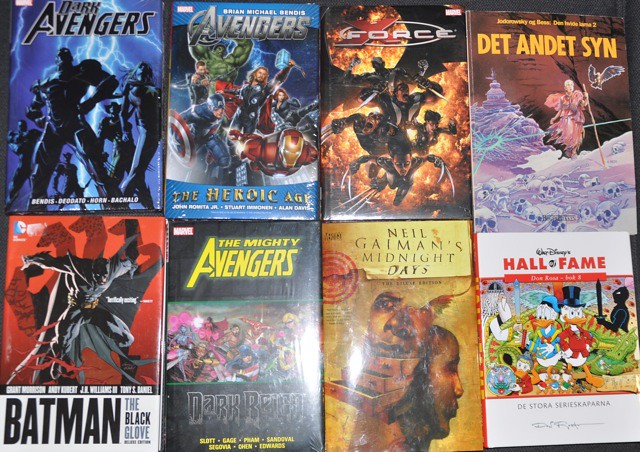
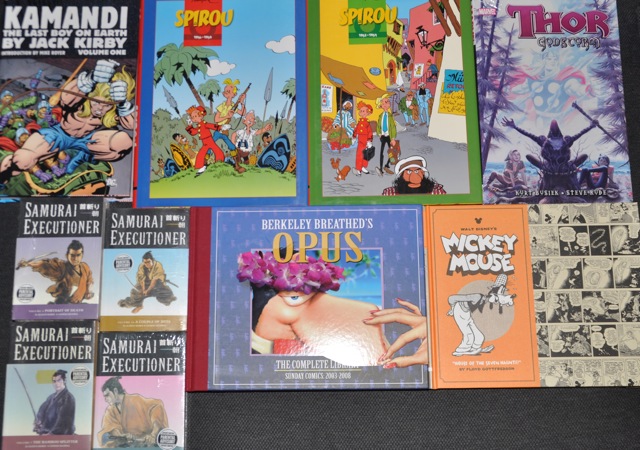
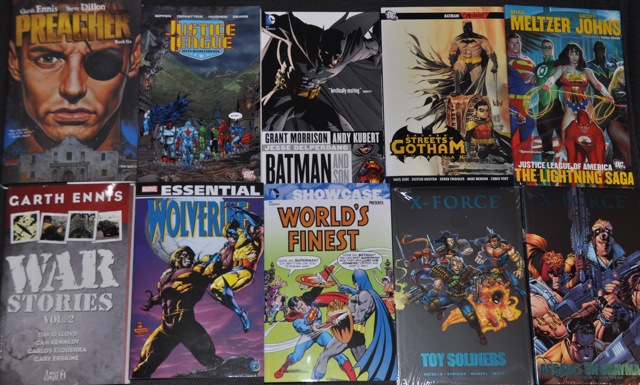
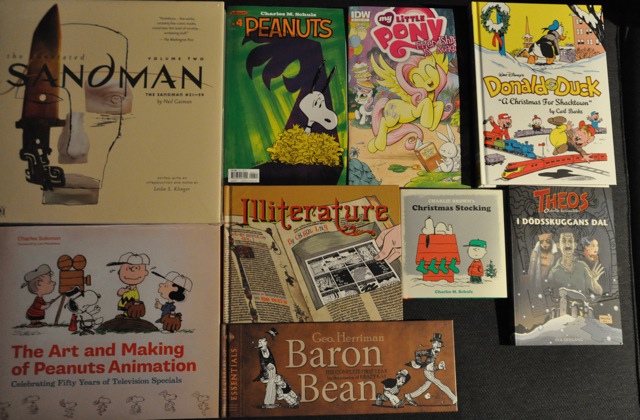
Back from the Comics Store, Nov 2012b Edition
In my defense, not only had my monthly comics come in, they were also having a bit of a sale.
I'm hoping for a long, peaceful Christmas vacation to read them all. (Not that that'll happen.)
Prenumerera på:
Inlägg (Atom)