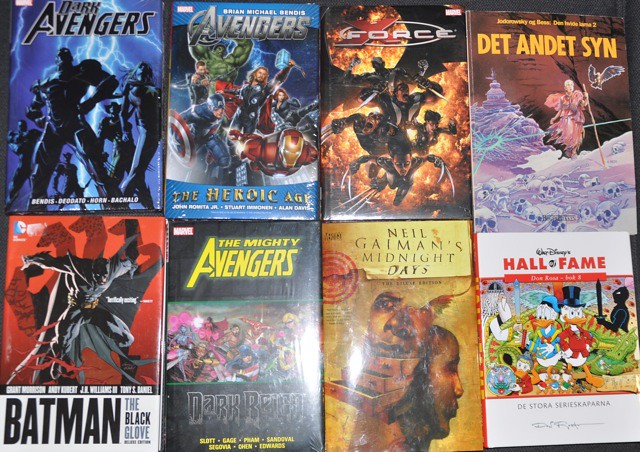
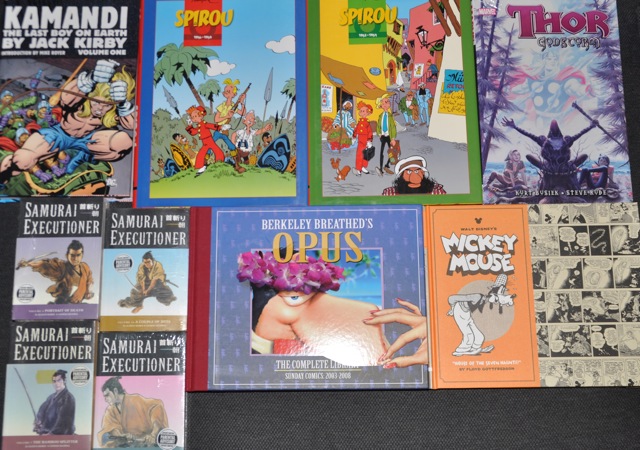
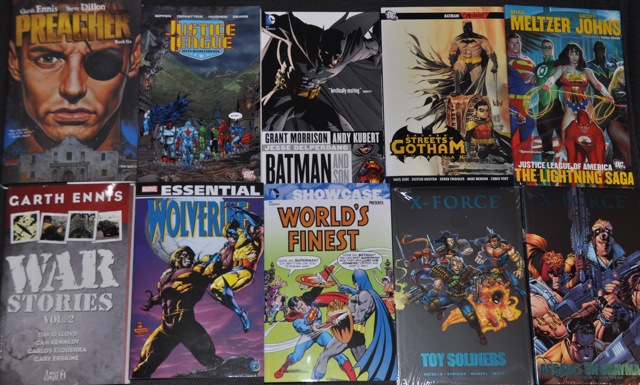
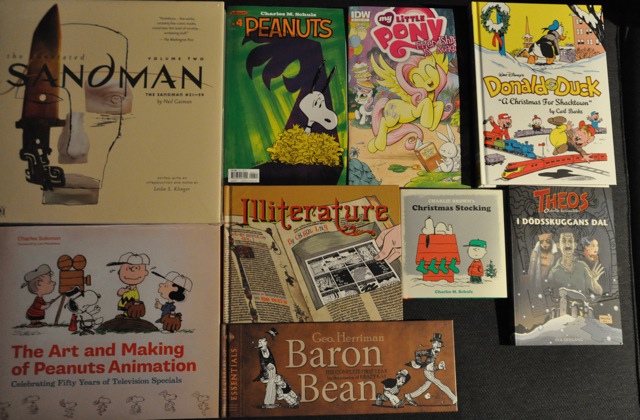
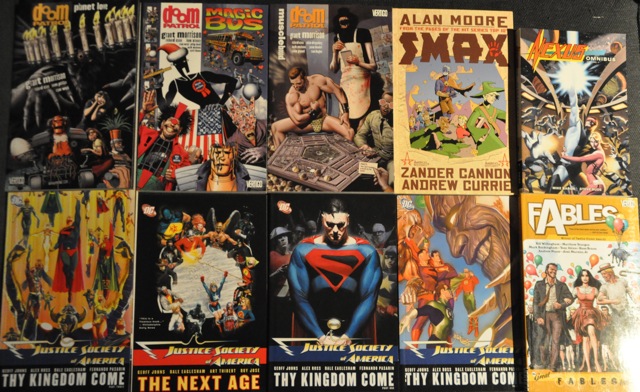
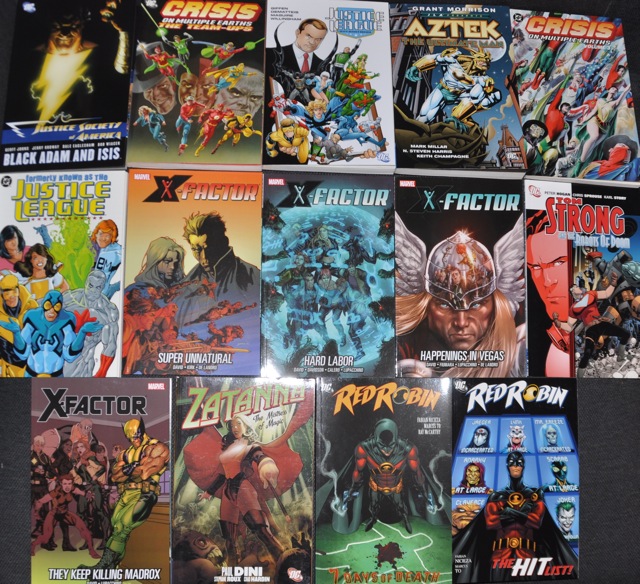
OK, so I bought some comics.
A lot of this is old classics, but there's some newer stuff as well. The Manara X-Men – or rather, X-Women – version pretty much sucked, but that wasn't really a surprise. The new Justice League had its good points and its bad points; I wasn't particularly pleased with the personalities of the new Hal Jordan or the new Wonder Woman, but overall Geoff Jones' script was quite good (as expected). The weak art by Jim Lee was a letdown, though.
Also a pretty humdrum issue of the Peanuts comic, I'm afraid. We'll see what I have time to read next.
(Man, those artist's editions are great, but damn, how they hurt your wallet.)
fredag 8 februari 2013
Peter Milligan & Mikel Janin: Justice League Dark Vol 1: In the Dark
OK, so everything's falling to pieces, right? There's this young woman on the run from monsters and stuff, and she keeps getting killed, right? Only it's not actually her getting killed, but the world is obviously seriously out of whack, an so's Shade, the Changing Man, by the way: he keeps creating women that aren't really real, and his relationships with them always end up sour, not just sick – but he doesn't seem able to help himself.
Anyway, Zatanna goes to face the Enchantress alone and is handily defeated. She's saved from the protective coma she puts herself in by John Constantine, whom she's apparently had it off with in the past. They argue, he disappears, and for some undisclosed reason Zatanna then feels it would be a good idea to have another go at the Enchantress – alone.
Etc. Credibility basically falls apart at a very early stage in this book. I can accept a person being pursued by demons and being repeatedly killed while not actually dying; after all, I'm a pretty seasoned superhero comics reader, but the JLA just walking away from an obviously dire threat to the world, that's just not on.
And it doesn't get better, as Zatannas unexplained desire to go and get her ass kicked once more by the Enchantress illustrates. The story is told so disjointedly that there isn't time to do the character development Milligan seems to want to do; for example, when he introduces the characters' sexuality in the story, it generally comes off as more kinky and tacky than interesting (the exception being the obviously desperately lonely and unhappy Shade). Madame Xanadu's rationale for creating the very menace she then tries to gather people to fight remains unclear to the very end. The horrors created by the Enchantress are mentioned en passant in a matter-of-fact manner that is probably intended to make them all the more scary, but it doesn't work. The method used, brief summaries like "In a neighboring town, a shower of books in a dead language kill six people"sounds like something Grant Morrison might use (in fact, it sounds so Morrisonesque that I kept wondering if it was a quote), but Milligan's story is already so disjointed that it just comes off as something he threw in because he couldn't be bothered to make something more coherent.
It would have been more OK had Milligan been so cavalier with these parts of the story, the logical structure of it, in order to focus on the personalities and problems of his main characters, the mystical heroes who in the end have to go up against The Enchantress – but as noted, I don't think he really succeeds in telling a good story about them, either. He doesn't really manage to elevate it above "these are pretty screwed-up people", and people like Steve Gerber already did that over at Marvel as early as the seventies (and better).
Nor does the art manage to provide the stability and structure the writing is lacking. The first couple of pages actually look awful, with no elegant linework and colors that are just dull and bland, and while the art picks up after that, it never reaches the exquisite elegance of Ryan Sook's cover art. Worse, it never manages to take charge and push the storytelling, either, even though the script practically cries out for that sort of help. The art more or less illustrates the script, and since the script is lacking in vigor and drive, perhaps it is fitting that the art is, as well.
(The book lists no less than three editors for the original story; perhaps this is why the firm editorial hand this story seems to be crying out for wasn't there.)
I've read far better from Milligan, and Janin's character sketches at the end of the book show ore promise than this, but regardless of the two creators' individual talents, this wasn't really worth it. Not recommended.
![]() |
| The gorgeous cover art by Ryan Sook raised my expectations to quite unjustified levels. |
It seems that that describes the Enchantress as well; apparently she's gone mad, and her madness is rippling through reality, tearing it apart. Thus, the Justice League has sent its heavy-hitters – Superman, Wonder Woman, Cyborg – to deal with her. They didn't think it necessary to let their magical expert Zatanna tag along, though, and are swiftly – far too swiftly and easily, IMO – defeated by a swarm of flying teeth. They are not heard from again for the rest of the book. Apparently, a lethal threat against the world, a threat strong enough to dismiss Superman, Wonder Woman and Cyborg with ease, doesn't warrant the JLA's attention anymore.
So Zatanna decides to have a go at the Enchantress herself. Meanwhile, the young woman being hounded and killed – or rather, simulacra of whom are being killed – finds Boston Brand, Deadman, and asks him for help. Since he's just offended his girlfriend Dove by making some somewhat kinky sex suggestions, he's currently quite free to help June, as the young woman called. More help is in the offering, it seems: Madame Xanadu is trying to gather a team of supernatural heroes to fight the Enchantress. Unfortunately, they're mostly not really all that eager to join – and besides, it seems Madame Xanadu is also simultaneously egging the Enchantress on in her madness and destructivity.
Anyway, Zatanna goes to face the Enchantress alone and is handily defeated. She's saved from the protective coma she puts herself in by John Constantine, whom she's apparently had it off with in the past. They argue, he disappears, and for some undisclosed reason Zatanna then feels it would be a good idea to have another go at the Enchantress – alone.
Etc. Credibility basically falls apart at a very early stage in this book. I can accept a person being pursued by demons and being repeatedly killed while not actually dying; after all, I'm a pretty seasoned superhero comics reader, but the JLA just walking away from an obviously dire threat to the world, that's just not on.
And it doesn't get better, as Zatannas unexplained desire to go and get her ass kicked once more by the Enchantress illustrates. The story is told so disjointedly that there isn't time to do the character development Milligan seems to want to do; for example, when he introduces the characters' sexuality in the story, it generally comes off as more kinky and tacky than interesting (the exception being the obviously desperately lonely and unhappy Shade). Madame Xanadu's rationale for creating the very menace she then tries to gather people to fight remains unclear to the very end. The horrors created by the Enchantress are mentioned en passant in a matter-of-fact manner that is probably intended to make them all the more scary, but it doesn't work. The method used, brief summaries like "In a neighboring town, a shower of books in a dead language kill six people"sounds like something Grant Morrison might use (in fact, it sounds so Morrisonesque that I kept wondering if it was a quote), but Milligan's story is already so disjointed that it just comes off as something he threw in because he couldn't be bothered to make something more coherent.
It would have been more OK had Milligan been so cavalier with these parts of the story, the logical structure of it, in order to focus on the personalities and problems of his main characters, the mystical heroes who in the end have to go up against The Enchantress – but as noted, I don't think he really succeeds in telling a good story about them, either. He doesn't really manage to elevate it above "these are pretty screwed-up people", and people like Steve Gerber already did that over at Marvel as early as the seventies (and better).
![]() |
| The bland art does little to enhance the too-incoherent script. |
Nor does the art manage to provide the stability and structure the writing is lacking. The first couple of pages actually look awful, with no elegant linework and colors that are just dull and bland, and while the art picks up after that, it never reaches the exquisite elegance of Ryan Sook's cover art. Worse, it never manages to take charge and push the storytelling, either, even though the script practically cries out for that sort of help. The art more or less illustrates the script, and since the script is lacking in vigor and drive, perhaps it is fitting that the art is, as well.
(The book lists no less than three editors for the original story; perhaps this is why the firm editorial hand this story seems to be crying out for wasn't there.)
I've read far better from Milligan, and Janin's character sketches at the end of the book show ore promise than this, but regardless of the two creators' individual talents, this wasn't really worth it. Not recommended.
torsdag 31 januari 2013
Antony Johnston & Eduardo Barreto: The Long Haul
Now, who doesn't like a good caper movie?
Because that is what this is, a caper movie. Cody Plummer is a con man & robber who's inserted himself into polite society in Chicago after doing a prison term several years earlier, a prison term that has left him with a rather deep resentment for the Pinkerton agent who put him there. Now that Pinkerton agent is in charge of a tremendous amount of money being transported by train to San Francisco, and of course it's going to be protected in a manner that makes it impossible to steal, with a special safe in a special armored car designed by none other than George Pullman himself, and an armed escort. Plus, if the train's late for a stop, a posse will be organized and sent out to catch any train robbers.
So naturally, Plummer collects a team to take the almost two million dollars away from the federal government. (After all, he's entitled to it, isn't he? Heck, he was sent to prison by this Pinkerton agent for robbing banks, and if that doesn't entitle you to rob the government of people's tax dollars, I don't know what does.) His first recruit is an old lover, currently making her living as a prostitute-slash-thief, and then follows the obligatory pattern of seeking out various potential gang members – including a money launderer – and trying to persuade them.
This process takes up a bit more than half the book, which is a bit unfortunate as the various recruitings never get particularly exciting (at least not if you've already seen a couple of caper movies and know the genre). Then comes the caper itself, exquisitely planned and put into action – but will it hit a snag and fail?
The nice parts are, it is indeed a well-planned scheme, and Barreto's style is nice, clean and crisp, and very competent. The weaknesses? Well, the script mainly seems to be touching the bases; it's like Johnston had a list of what should be in a caper movie, and checked off that list while writing the script. The dialogue is adequate but nothing more, and, well, that's pretty much how I'd sum up the whole script. And unfortunately, that pretty close to describing Barreto's art as well. It's very competent, don't get me wrong, but when the script doesn't deliver enough pizzazz to keep me riveted, Barreto would have had to give me more than he does here. He tells the story, but just like a caper movie would have to compensate for a humdrum script with exciting acting and cutting, as well as judicious use of the soundtrack, this story needed Neal Adams- or Gil Kane-level exciting graphics. (Or Joe Kubert. If it's a western, you just cannot go wrong with Joe Kubert.)
So, unfortunately not recommended. But I would love to see Barreto illustrate a well-written Modesty Blaise- or Rip Kirby-type story.
Because that is what this is, a caper movie. Cody Plummer is a con man & robber who's inserted himself into polite society in Chicago after doing a prison term several years earlier, a prison term that has left him with a rather deep resentment for the Pinkerton agent who put him there. Now that Pinkerton agent is in charge of a tremendous amount of money being transported by train to San Francisco, and of course it's going to be protected in a manner that makes it impossible to steal, with a special safe in a special armored car designed by none other than George Pullman himself, and an armed escort. Plus, if the train's late for a stop, a posse will be organized and sent out to catch any train robbers.
So naturally, Plummer collects a team to take the almost two million dollars away from the federal government. (After all, he's entitled to it, isn't he? Heck, he was sent to prison by this Pinkerton agent for robbing banks, and if that doesn't entitle you to rob the government of people's tax dollars, I don't know what does.) His first recruit is an old lover, currently making her living as a prostitute-slash-thief, and then follows the obligatory pattern of seeking out various potential gang members – including a money launderer – and trying to persuade them.
This process takes up a bit more than half the book, which is a bit unfortunate as the various recruitings never get particularly exciting (at least not if you've already seen a couple of caper movies and know the genre). Then comes the caper itself, exquisitely planned and put into action – but will it hit a snag and fail?
The nice parts are, it is indeed a well-planned scheme, and Barreto's style is nice, clean and crisp, and very competent. The weaknesses? Well, the script mainly seems to be touching the bases; it's like Johnston had a list of what should be in a caper movie, and checked off that list while writing the script. The dialogue is adequate but nothing more, and, well, that's pretty much how I'd sum up the whole script. And unfortunately, that pretty close to describing Barreto's art as well. It's very competent, don't get me wrong, but when the script doesn't deliver enough pizzazz to keep me riveted, Barreto would have had to give me more than he does here. He tells the story, but just like a caper movie would have to compensate for a humdrum script with exciting acting and cutting, as well as judicious use of the soundtrack, this story needed Neal Adams- or Gil Kane-level exciting graphics. (Or Joe Kubert. If it's a western, you just cannot go wrong with Joe Kubert.)
So, unfortunately not recommended. But I would love to see Barreto illustrate a well-written Modesty Blaise- or Rip Kirby-type story.
Etiketter:
Antony Johnston,
caper,
Eduardo Barreto
torsdag 6 december 2012
lördag 1 december 2012
Back from the Comics Store, Nov 2012b Edition
In my defense, not only had my monthly comics come in, they were also having a bit of a sale.
I'm hoping for a long, peaceful Christmas vacation to read them all. (Not that that'll happen.)
fredag 30 november 2012
My t-shirts, part 55: Uncle Sam
The Uncle Sam two-part Vertigo series had gorgeous art by Alex Ross, but suffered from a major plotline weakness – I already know enough of U.S. history that I'm not exactly surprised, baffled or provoked by being told about some of the less savory things that nation has done over the years. So it was a kind of "Meh" book IMO.
But the art is still gorgeous.
onsdag 21 november 2012
tisdag 20 november 2012
The Art of Comics. A Philosophical Approach. Edited by Aaron Meskin and Roy T Cook
I've always been a bit suspicious when people from the so-called "high culture" sphere descend to the comics sphere to apply its tools and sensibilities on it. Basically, this distrust is based on a bunch of instances where I've seen people apply not so much tools and sensibilities as 1) prejudices and ignorance, and 2) political opinionating.
Now, I've got nothing against political opinionating per se; in fact, I've been known to engage in it myself from time to time, but when you let it take over what was supposed to be an essay or article about a particular comic, you sort of lose the purpose of writing about that comic, don't you? And, if you're arguing that Donald Duck comics are inherently imperialistic, or that The Phantom is inherently racist, you're just putting forth your own prejudices and ignorance, anyway.
The people – or, more precisely, the philosophers – behind the essays in The Art of Comics aren't prejudiced and ignorant, however. Instead, they seem genuinely interested in, and knowledgeable about, the subjects they address in 10 rather diverse essays. I disagree with them on a lot of things, but that's not because they're ignorant or stupid, it's just because I think they got some things wrong, and that could happen to anybody (even myself on occasion, I must confess).
I'll address my problems with some of the analyses in the book, but I'd of course encourage anyone to read the book themselves and form their own opinion. Here goes:
Chapter 1: Redefining Comics, by John Holbo
… argues that the definition of comics should include daily panels, like the Family Circus. His reasoning seems to be that comics evolved out of Punch-style cartoons, that it's to hard to exclude works like Michelangelo's roof to the Sixtine Chapel etc. with McCloud's definition, and that even one-panel cartoons are sequential; a sequence of one that implies several different moment within itself.
I can't agree with Holbo's reasoning. There is a clear difference between having to imply different moments within a panel and being able to choose to do so if you want to, because it furthers your narrative better than doing so in two or more panels. And we most certainly don't have to let the Family Circus into the comics family just because the Bayeux Tapestry doesn't look like ordinary comics, that's not a logical reason.
Chapter 2: The Ontology of Comics, by Aaron Meskin
… addresses the definition of comics from a different angle; that by defining them as multiple works of art, you can get past the problems of other definitions (like McCloud's) with excluding certain works of art from the category of comics. "[C]omics and graphic novels are typically multiple works of art rather than mere copies, and in virtue of this they allow for simultaneous but spatially-distinct and unconnected reception points. In other words, different people can experience them at the same time and in significantly different locations."
I think both Holbo and Meskin are needlessly complicates the issue of definitions. If they'd separate the form of comics from the published works, they'd probably be able to escape some of the problems with the definitions that they now have to jump through all sorts of rhetorical hoops to try to solve. Thus, the original pages that would be published in the legendary Action Comics issue were in the comics form, and the printed pages were also. And honestly, the Sixtine Chapel roof isn't really comics at all, and it's really not all that hard to exclude it even from a McCloud-ish definition. What we have to realize is that definitions – at least in the humanities – tend to get very fuzzy at the edges when you look at them closely enough. The solution to that isn't generally to add more complexity to the definition that creates new fuzzy areas while making it more unwieldy, but to apply a modicum of common sense when making a judgement of what to include and exclude at those fuzzy edges of the definition.
Chapter 3: Comics and Collective Authorship, by Christy Mag Uidhir
… looks at the problem of who should be counted as author in collectively created works with an editor, writer, penciller, inker, colorist, and a letterer. Uidhir's solution is to a) use the formula "authorship-of-a-work-as-'X'" rather than "authorship-of-a-work", b) try to decide whether the contribution a person makes is sufficiently substantive to him/her count as one of the authors.
I really don't think those conclusions warrant the formal logic that precedes them as Uidhir builds his case; they're a little bit too easy to reach by commonsense reasoning.
Now, I've got nothing against political opinionating per se; in fact, I've been known to engage in it myself from time to time, but when you let it take over what was supposed to be an essay or article about a particular comic, you sort of lose the purpose of writing about that comic, don't you? And, if you're arguing that Donald Duck comics are inherently imperialistic, or that The Phantom is inherently racist, you're just putting forth your own prejudices and ignorance, anyway.
The people – or, more precisely, the philosophers – behind the essays in The Art of Comics aren't prejudiced and ignorant, however. Instead, they seem genuinely interested in, and knowledgeable about, the subjects they address in 10 rather diverse essays. I disagree with them on a lot of things, but that's not because they're ignorant or stupid, it's just because I think they got some things wrong, and that could happen to anybody (even myself on occasion, I must confess).
I'll address my problems with some of the analyses in the book, but I'd of course encourage anyone to read the book themselves and form their own opinion. Here goes:
Chapter 1: Redefining Comics, by John Holbo
… argues that the definition of comics should include daily panels, like the Family Circus. His reasoning seems to be that comics evolved out of Punch-style cartoons, that it's to hard to exclude works like Michelangelo's roof to the Sixtine Chapel etc. with McCloud's definition, and that even one-panel cartoons are sequential; a sequence of one that implies several different moment within itself.
I can't agree with Holbo's reasoning. There is a clear difference between having to imply different moments within a panel and being able to choose to do so if you want to, because it furthers your narrative better than doing so in two or more panels. And we most certainly don't have to let the Family Circus into the comics family just because the Bayeux Tapestry doesn't look like ordinary comics, that's not a logical reason.
Chapter 2: The Ontology of Comics, by Aaron Meskin
… addresses the definition of comics from a different angle; that by defining them as multiple works of art, you can get past the problems of other definitions (like McCloud's) with excluding certain works of art from the category of comics. "[C]omics and graphic novels are typically multiple works of art rather than mere copies, and in virtue of this they allow for simultaneous but spatially-distinct and unconnected reception points. In other words, different people can experience them at the same time and in significantly different locations."
I think both Holbo and Meskin are needlessly complicates the issue of definitions. If they'd separate the form of comics from the published works, they'd probably be able to escape some of the problems with the definitions that they now have to jump through all sorts of rhetorical hoops to try to solve. Thus, the original pages that would be published in the legendary Action Comics issue were in the comics form, and the printed pages were also. And honestly, the Sixtine Chapel roof isn't really comics at all, and it's really not all that hard to exclude it even from a McCloud-ish definition. What we have to realize is that definitions – at least in the humanities – tend to get very fuzzy at the edges when you look at them closely enough. The solution to that isn't generally to add more complexity to the definition that creates new fuzzy areas while making it more unwieldy, but to apply a modicum of common sense when making a judgement of what to include and exclude at those fuzzy edges of the definition.
Chapter 3: Comics and Collective Authorship, by Christy Mag Uidhir
… looks at the problem of who should be counted as author in collectively created works with an editor, writer, penciller, inker, colorist, and a letterer. Uidhir's solution is to a) use the formula "authorship-of-a-work-as-'X'" rather than "authorship-of-a-work", b) try to decide whether the contribution a person makes is sufficiently substantive to him/her count as one of the authors.
I really don't think those conclusions warrant the formal logic that precedes them as Uidhir builds his case; they're a little bit too easy to reach by commonsense reasoning.
Chapter 4: Comics and Genre, by Catharine Abell
… tries to define what is genre in comics but gets a bit lost in all the categories and terminology, proposing that "genres are sets of conventions that have developed as means of adressing particular interpretative and/or evaluative problems, and have a history of co-instantation within a community, such that a work's belonging to some genre generates interpretative and evaluative expectations among the members of that community. To belong to some genre, a work must be produced in a community in which its constitutive conventions have a history of co-instantiation and must be produced in accordance with some subset of those conventions that is sufficient to distinguish the set of conventional at issue from all other sets of conventions that have developed as means of addressing interpretative and/or evaluative concerns and have a history of co-instantiation within the community in which the work was produced. A work is produced in accordance with a convention if and only if it both has features of the type picked out by the convention at issue and its maker gave the work those features so that the convention would apply to it."
Not only is that simply too convoluted, I really don't understand why a work couldn't be assigned to a genre based on its own qualities, regardless of what intentions the creator had when creating it. Basically, to me, Abell's chapter (like Uidhir's) addresses what is pretty much a non-problem.
… tries to define what is genre in comics but gets a bit lost in all the categories and terminology, proposing that "genres are sets of conventions that have developed as means of adressing particular interpretative and/or evaluative problems, and have a history of co-instantation within a community, such that a work's belonging to some genre generates interpretative and evaluative expectations among the members of that community. To belong to some genre, a work must be produced in a community in which its constitutive conventions have a history of co-instantiation and must be produced in accordance with some subset of those conventions that is sufficient to distinguish the set of conventional at issue from all other sets of conventions that have developed as means of addressing interpretative and/or evaluative concerns and have a history of co-instantiation within the community in which the work was produced. A work is produced in accordance with a convention if and only if it both has features of the type picked out by the convention at issue and its maker gave the work those features so that the convention would apply to it."
Not only is that simply too convoluted, I really don't understand why a work couldn't be assigned to a genre based on its own qualities, regardless of what intentions the creator had when creating it. Basically, to me, Abell's chapter (like Uidhir's) addresses what is pretty much a non-problem.
Chapter 5: Wordy pictures: Theorizing the Relationship between Image and Text in Comics, by Thomas E. Wartenberg
… argues that the image is the most important part of the comic as it doesn't need words to be comics, and it's hard to disagree with that, but it's also hard to see it as an important breakthrough. He also doesn't want to exclude single-panels from the comics definition, but again the reasons for doing so seem a bit thin. Wartenberg points to how The Yellow Kid is generally held to be the first newspaper strip besides being a single panel comic, but that something "is held to be" something by some is a pretty poor argument for defining it that way.
Again, I think something would be gained from separating the definition of the comic form – basically a sequence of pictures (intentionally) creating a narrative – from the issue of whether some published work should count as a "comic" or not. For example, The Far Side is a cartoon that occasionally used the comics format (like with the cow walking up to the farmer's door, ringing the doorbell, and then returning to grazing before the bewildered farmer opened the door), whereas Peanuts is a comic strip that occasionally was comprised of a single panel. While the strip wasn't in a comics but a cartoon format in those instances, there's little doubt that Peanuts was a comic strip overall.
… argues that the image is the most important part of the comic as it doesn't need words to be comics, and it's hard to disagree with that, but it's also hard to see it as an important breakthrough. He also doesn't want to exclude single-panels from the comics definition, but again the reasons for doing so seem a bit thin. Wartenberg points to how The Yellow Kid is generally held to be the first newspaper strip besides being a single panel comic, but that something "is held to be" something by some is a pretty poor argument for defining it that way.
Again, I think something would be gained from separating the definition of the comic form – basically a sequence of pictures (intentionally) creating a narrative – from the issue of whether some published work should count as a "comic" or not. For example, The Far Side is a cartoon that occasionally used the comics format (like with the cow walking up to the farmer's door, ringing the doorbell, and then returning to grazing before the bewildered farmer opened the door), whereas Peanuts is a comic strip that occasionally was comprised of a single panel. While the strip wasn't in a comics but a cartoon format in those instances, there's little doubt that Peanuts was a comic strip overall.
Chapter 6: What's So Funny? Comic Content in Depiction, by Patrick Maynard
… basically argues that humor strips signal their ephemeral content by being published on the comics page and by being drawn in a simple, cartoony style.
Chapter 7: The Language of Comics, by Darren Hudson Hick
… treats panels as a basic unit in the not language but syntax of comics. I do think Hick, as a philosopher, is perhaps a bit too eager to try and understand comics as a language akin to natural languages, when it is in fact anything but, but he reaches the pretty reasonable conclusion that "although discussing comics as a natural language is perhaps a strech, it seems not unreasonable to talk of them as being language-like – as constituting a pseudo-language – operating in many ways like a natural language." Like I said, not unreasonable, but why treat comics as a "pseudo-languages" instead of just comics? Why not just analyze how comics actually achieve the effects they achieve?
Chapter 8: Making Comics into Film, by Henry John Pratt
… makes the somewhat silly argument that comics are especially good to adapt into movies because they unlike paintings are narrative, and unlike literature works with pictures, and are already cut into scenes just like films are.
(There are a couple of chapters more, but I didn't find them sufficiently interesting to take extensive notes on them.)
So, there you have it. Quite obviously, I have a lot of reservations about the analyses and conclusions put forth in this book, but I applaud the authors and editors for the effort, and would encourage anybody with a serious interest in the comics medium to read it and make up their own mind.
… But I do think you'll actually get way more insights about the comics medium by reading Scott McCloud's Understanding Comics and Making Comics. Seriously.
måndag 19 november 2012
I did this! This summer...
... while moving into a new house and trying to get myself and my comics, books etc. settled there... There have been periods of my life during which I've felt less stressed-out.
![]() |
| "You're a disgrace to the Army! I want to see superheroes!" A tie-in with the Avengers movie (which was excellent, btw). |
![]() |
| "Now, before we start, has everyone been to the bathroom?" |
söndag 18 november 2012
Brant Parker & Johnny Hart: The Wizard of Id. Dailies and Sundays 1972
In my teens, I read quite a lot of collections of daily strips. There were these cheap pocketbook collections of B.C., The Wizard of Id, Peanuts, etc, that I used to buy when we went from my small town home of Ånge to visit relatives in a real city like Östersund, which had proper bookstores. I loved Peanuts, and the rest of them were usually OK, but not up to the same standards – but hey, they were comics, so I read 'em.
Occasionally, my love of comics would lead me into the realm of cultural discourse – the gorgeous artwork of someone like Neal Adams would inspire an interest in fine art in general, sometimes the prominent culturati of the time would discuss comics (unfortunately rarely with any particularly impressive amount of knowledge about the subject), or some left-oriented critic would put out an article or a book condemning the USA-produced trash that was supposedly indoctrinating innocent kids into a capitalistic, imperialistic and evil worldview.
I remember reading a particularly galling review of a collection of comics dailies, where the reviewer complained that it was tiresome to read the whole collection because it got repetitive and the strips probably weren't intended to be collected into a book like that. First of all: well, duh – they were intended to be published as daily strips in a newspaper; collecting them was a bonus for people who liked the strip. Second, I don't recall what strip it was, but if it was Peanuts, the reviewer must have been an idiot, because any chance to read Peanuts strips is a treat to be savored.
And finally, the reviewer was an idiot, because how bloody hard can it be to simply put the book away and do something else for a while, and then come back and pick it up to read some more when you feel like it? After all, you can probably manage to do so with novels of short story collections, so how hard can it be to do the same when the book contains comic strips instead? Good grief.
Anyway, what this rambling leads up to is my appreciation for today's quite excellent trend of collecting old strips in complete editions, and more precisely Titan Books' The Wizard of Id. Dailies and Sundays 1972.
The Wizard of Id wasn't exactly one of my favorites; partly because the art wasn't as clean or pretty as in some other strips, partly because the jokes just didn't seem quite as funny. A lot of them were about how fat, ugly and unpleasant the Wizard's wife was, and I'd already read plenty enough of that kind of jokes to be kind of tired of them.
Re-reading the strip today, I have to say that I agree with my younger self. Apart from the "ugly wife" strips, there are strips with puns, strips with "short" jokes about the diminutive king of Id, booze jokes about the alcoholic court jester Bung, and contemporary jokes about women's lib etc. Some of the jokes work, some don't, but generally, the strip never really takes off. Like B.C. and Peanuts, The Wizard of Id was considered a "sophisticated" strip in those days. The term referred to how that sort of strips worked with words and small effects instead of "bigfoot" cartooning (of which Beetle Bailey would be the foremost example), slapstick and wild, grandiose, physical humor, and for that purpose, I suppose I'll go along with it. But Parker et al – and most of the other strips in that tradition – while often clever in their puns, put-downs etc, never reached the level of sophistication that Charles Schulz managed to achieve, really creating Art by sublimating his neuroses, anxieties and aspirations into a cohesive, captivating whole.
Nevertheless, my hat's off to Titan Books for collecting this bit of comics history into a nice, appealing package, and I hope they continue to do so, even though I won't recommend it. I would, however, recommend them to remove the annoying "JohnnyHartStudios.com" sticker that is in Every-Bloody-Strip mucking them up graphically and distracting the reader from what's important: the actual strips. (If they could also get the copyright stickers out of the panels and into the gutters instead, and preferably also make it just a smidgeon smaller, that would also be appreciated.)
Oh, and it does get a bit tiresome to read long stretches of the strip, because it is kind of scratchy in its artwork and kind of repetitive in its humor. It probably wasn't intended to be read like this, strip after strip after strip in a whole book.
But you know what? That's not really a problem. You can read a month or so at a time, put the book away for a couple of hours or a day or two, and then return to read some more.
That is, if you're not too stupid to figure that out.
Occasionally, my love of comics would lead me into the realm of cultural discourse – the gorgeous artwork of someone like Neal Adams would inspire an interest in fine art in general, sometimes the prominent culturati of the time would discuss comics (unfortunately rarely with any particularly impressive amount of knowledge about the subject), or some left-oriented critic would put out an article or a book condemning the USA-produced trash that was supposedly indoctrinating innocent kids into a capitalistic, imperialistic and evil worldview.
I remember reading a particularly galling review of a collection of comics dailies, where the reviewer complained that it was tiresome to read the whole collection because it got repetitive and the strips probably weren't intended to be collected into a book like that. First of all: well, duh – they were intended to be published as daily strips in a newspaper; collecting them was a bonus for people who liked the strip. Second, I don't recall what strip it was, but if it was Peanuts, the reviewer must have been an idiot, because any chance to read Peanuts strips is a treat to be savored.
And finally, the reviewer was an idiot, because how bloody hard can it be to simply put the book away and do something else for a while, and then come back and pick it up to read some more when you feel like it? After all, you can probably manage to do so with novels of short story collections, so how hard can it be to do the same when the book contains comic strips instead? Good grief.
Anyway, what this rambling leads up to is my appreciation for today's quite excellent trend of collecting old strips in complete editions, and more precisely Titan Books' The Wizard of Id. Dailies and Sundays 1972.
The Wizard of Id wasn't exactly one of my favorites; partly because the art wasn't as clean or pretty as in some other strips, partly because the jokes just didn't seem quite as funny. A lot of them were about how fat, ugly and unpleasant the Wizard's wife was, and I'd already read plenty enough of that kind of jokes to be kind of tired of them.
Re-reading the strip today, I have to say that I agree with my younger self. Apart from the "ugly wife" strips, there are strips with puns, strips with "short" jokes about the diminutive king of Id, booze jokes about the alcoholic court jester Bung, and contemporary jokes about women's lib etc. Some of the jokes work, some don't, but generally, the strip never really takes off. Like B.C. and Peanuts, The Wizard of Id was considered a "sophisticated" strip in those days. The term referred to how that sort of strips worked with words and small effects instead of "bigfoot" cartooning (of which Beetle Bailey would be the foremost example), slapstick and wild, grandiose, physical humor, and for that purpose, I suppose I'll go along with it. But Parker et al – and most of the other strips in that tradition – while often clever in their puns, put-downs etc, never reached the level of sophistication that Charles Schulz managed to achieve, really creating Art by sublimating his neuroses, anxieties and aspirations into a cohesive, captivating whole.
![]() |
| Actually, I think this is a pretty decent joke, as jokes go. But this is as good as it gets. |
Nevertheless, my hat's off to Titan Books for collecting this bit of comics history into a nice, appealing package, and I hope they continue to do so, even though I won't recommend it. I would, however, recommend them to remove the annoying "JohnnyHartStudios.com" sticker that is in Every-Bloody-Strip mucking them up graphically and distracting the reader from what's important: the actual strips. (If they could also get the copyright stickers out of the panels and into the gutters instead, and preferably also make it just a smidgeon smaller, that would also be appreciated.)
Oh, and it does get a bit tiresome to read long stretches of the strip, because it is kind of scratchy in its artwork and kind of repetitive in its humor. It probably wasn't intended to be read like this, strip after strip after strip in a whole book.
But you know what? That's not really a problem. You can read a month or so at a time, put the book away for a couple of hours or a day or two, and then return to read some more.
That is, if you're not too stupid to figure that out.
Prenumerera på:
Inlägg (Atom)