Cartoonist Kyle Baker has produced a number of brilliant works, but my favorites remain the early ones. The Cowboy Wally Show is a flawed masterpiece, which starts out as one thing and then – because Baker didn't have enough material but lied to the publisher and said he did, and then had to produce it for the book – turns into something slightly, and oddly different. But that flaw is what makes it such a masterpiece; the absurdity of the (wicked) humor in the different chapters matches the sense of disconnectedness between the chapters, and the result is brilliantly funny and irresistably charming. If you can get your hands on it, do so.
Baker, disgusted with certain elements of the comics industry – like having to do things the way editors told him to – then went on to produce what is essentially a sitcom/Neil Simon movie in comics format, Why I Hate Saturn. With its sharp, clever and really funny dialogue, it would have been a masterpiece even if Baker's art hadn't been so exquisite. Also a must-read IMO.
And with that out of the way, we can now get to the actual subject of this review, namely Baker's self-published books of cartoons:
I have mixed feelings about these books. Baker's art is probably better than ever, but the jokes aren't really top-notch. Too many of them are of the "family strip humor" variety and lack something of the sharpness and edginess that make his best work so brilliant. A lot of it is OK jokes told in marvellous drawings, but the crisp, biting, sometimes absurd but always enjoyable and funny dialogue he excelled with in works like Cowboy Wally and Why I Hate Saturn is missing. It comes off a bit like one of those MAD paperbacks with Sergio Aragonés' cartoons, but lacking the never-ending stream of brilliant ideas that is Aragonés' hallmark.
And the MAD comparison is apt in more ways as well, as Baker's art reminds me of what you'd get if you managed to marry Mort Drucker's drawing style to that of Jack Davis – with a smidgeon of Jack Rickard, Bob Clarke etc. thrown in for good measure where needed. Occasional ventures into the MAD Magazine article style works well, too. But overall, this is too much Family Circus and not enough Aragonés or Frank Jacobs.
That doesn't mean that it's bad – besides, you may well prefer the recognition humor provided by the insights into the Bakers' family life that comprise not-quite-half of each book – and it's still worth reading for the brilliant drawing skills of Mr. Baker. But if you're going to buy something by him, I recommend starting with The Cowboy Wally Show and Why I Hate Saturn instead.
måndag 2 januari 2012
söndag 1 januari 2012
Galago #99: Nu blåser vi borgarna igen ("Screw the bourgeois – again")
The Swedish alternative-comics flagship Galago has a tradition of leftist social criticism and satire, and has recently declared itself dedicated to attacking the center-right government of Sweden. Previously, they'd done an issue before every election dedicated to attacking the center-right political side, but now that's a permanent direction of the magazine.
Galago #99 was published before the most recent election, in 2010. So how did it measure up? Well, not greatly, IMO – but since I'm a liberal, I'm probably not the intended audience.
The first story depicts a TV show in a future where the (basically racist) party Sverigedemokraterna ("The Sweden Democrats") is in power and executes people for being different under the motto "Bort med slöddret!" ("Get rid of the scum!"). It's a bit over the top and doesn't really address Sverigedemokraterna's policies, so it really comes off as mainly venting. And that's the problem with most of the comics in this issue – they're not really satirical; instead they're just angry people telling the reader that they're angry.
Now, venting is often personally satisfying, I'll grant them that, and reading somebody else venting about things that one is angry about oneself is also pretty satisfying. But that's also all it is. It doesn't bring any new knowledge, any new arguments, it's just emotionally satisfying. It's kinda like those people carrying around a sign of Pres. Obama as the Joker – they and their friends may go "Ha! Ha! That stupid Obama! I really got him good!", but they're not learning anything about actual policy in the bargain; instead they're just wasting valuable time and energy that could be better used educating themselves. Similarly, drawing a picture of the conservative Swedish prime minister as an ugly, big dick is probably very emotionally satisfying for people who hate him and his policies, but it's not really much in the way of satire.
So what else is there? Well, Mats Jonsson draws a short story about his communist youth, when it was considered very funny to accuse young conservatives of being Nazis. Sara Hansson does a good page on how to resist turning your rental building into a co-op – and it's good because she does a good job depicting the feeling of powerlessness that people might feel when such a decision goes against their wishes. Pontus Lundkvist does a really good story on people who complain about "political correctness", but IMO doesn't really manage turn it into the attack on the center-right as much as on a special brand of conspiratorically-minded (usually rather right-wing) people. Fabian Göransson – who's normally very good, and whose Inferno is worth your time – does a story about growing up in a wealthy, politically rightist suburb that starts out interesting but sort of fails to really go anywhere.
Sara Hansson then does a story about her fears of the EU and the political center-right parties, which starts out interesting – after all, she's talking about her own genuine emotions here – but which loses me when she tells about going out with her friends and tearing down the election posters of the center-right parties; I'm not a big fan of the "freedom of speech for me but not for thee" political theory. Sara Olausson does an initially amusing, zany story about a grownup Pippi Longstocking blackmailing her childhood friend Tommy into giving her a job (which turns out to be distributing anti-immigrant chauvinistic propaganda), but it peters out towards the end when she tries too hard to get a shoutout for the Anarcho-syndicalist Youth Federation into the story. Etc.
Again, the basic problem with most of the stories in this issue is that they're too much on the simplistic side. Some of them capture my interest with a personal story or a more personal touch, but on the whole, it's pretty tepid fare, and usually not very well drawn. Comparing it to some great American political satirists like Tom Tomorrow or Ruben Bolling, it's simply not even a competition (although admittedly, the US political scene is probably a lot easier to satirize than a Swedish center-right government – I sometimes find myself wondering what The Daily Show writers get paid for other than lifting large portions of crazy practically verbatim from the speeches of right-wing Republican politicians?). If you want Swedish political satire, perhaps you should try Max Gustafson instead. I don't really agree with him either, politically, but at least he's a bit funnier.
Not recommended.
Galago #99 was published before the most recent election, in 2010. So how did it measure up? Well, not greatly, IMO – but since I'm a liberal, I'm probably not the intended audience.
The first story depicts a TV show in a future where the (basically racist) party Sverigedemokraterna ("The Sweden Democrats") is in power and executes people for being different under the motto "Bort med slöddret!" ("Get rid of the scum!"). It's a bit over the top and doesn't really address Sverigedemokraterna's policies, so it really comes off as mainly venting. And that's the problem with most of the comics in this issue – they're not really satirical; instead they're just angry people telling the reader that they're angry.
Now, venting is often personally satisfying, I'll grant them that, and reading somebody else venting about things that one is angry about oneself is also pretty satisfying. But that's also all it is. It doesn't bring any new knowledge, any new arguments, it's just emotionally satisfying. It's kinda like those people carrying around a sign of Pres. Obama as the Joker – they and their friends may go "Ha! Ha! That stupid Obama! I really got him good!", but they're not learning anything about actual policy in the bargain; instead they're just wasting valuable time and energy that could be better used educating themselves. Similarly, drawing a picture of the conservative Swedish prime minister as an ugly, big dick is probably very emotionally satisfying for people who hate him and his policies, but it's not really much in the way of satire.
So what else is there? Well, Mats Jonsson draws a short story about his communist youth, when it was considered very funny to accuse young conservatives of being Nazis. Sara Hansson does a good page on how to resist turning your rental building into a co-op – and it's good because she does a good job depicting the feeling of powerlessness that people might feel when such a decision goes against their wishes. Pontus Lundkvist does a really good story on people who complain about "political correctness", but IMO doesn't really manage turn it into the attack on the center-right as much as on a special brand of conspiratorically-minded (usually rather right-wing) people. Fabian Göransson – who's normally very good, and whose Inferno is worth your time – does a story about growing up in a wealthy, politically rightist suburb that starts out interesting but sort of fails to really go anywhere.
Sara Hansson then does a story about her fears of the EU and the political center-right parties, which starts out interesting – after all, she's talking about her own genuine emotions here – but which loses me when she tells about going out with her friends and tearing down the election posters of the center-right parties; I'm not a big fan of the "freedom of speech for me but not for thee" political theory. Sara Olausson does an initially amusing, zany story about a grownup Pippi Longstocking blackmailing her childhood friend Tommy into giving her a job (which turns out to be distributing anti-immigrant chauvinistic propaganda), but it peters out towards the end when she tries too hard to get a shoutout for the Anarcho-syndicalist Youth Federation into the story. Etc.
Again, the basic problem with most of the stories in this issue is that they're too much on the simplistic side. Some of them capture my interest with a personal story or a more personal touch, but on the whole, it's pretty tepid fare, and usually not very well drawn. Comparing it to some great American political satirists like Tom Tomorrow or Ruben Bolling, it's simply not even a competition (although admittedly, the US political scene is probably a lot easier to satirize than a Swedish center-right government – I sometimes find myself wondering what The Daily Show writers get paid for other than lifting large portions of crazy practically verbatim from the speeches of right-wing Republican politicians?). If you want Swedish political satire, perhaps you should try Max Gustafson instead. I don't really agree with him either, politically, but at least he's a bit funnier.
Not recommended.
lördag 10 december 2011
Jason Aaron & Ron Garney: Ultimate Comics Captain America
The Ultimate Comics Captain America isn't quite like the Steve Rogers we've come to know and love in the standard Marvel Universe. He's cruder, doesn't mind shooting people, and is more chauvinistic. When the raid he leads against a North Korean installation goes to heck, he blames the "incompetent Brits", and he echoes the anti-French prejudice heard from so many on the American Right after France wouldn't support the Bush admin's Iraq invasion. So this counts against him as a hero in my book. You could explore such issues to make him a more fully-rounded character, of course, but that's usually not what mainstream superhero comics do.
Turns out that's not what Aaron and Garney do in Ultimate Comics Captain America, either.
The story is as follows: Cap is kept prisoner, in shackles. He attempts to escape, is caught, beaten, and a gun is put to his head. He starts praying. Disgusted, his captor leaves, saying he'll be back in five minutes and shoot Cap, and then he'll see how useless praying was.
Flashback starts.
Cap leads a raid on a North Korean compound, where attempts are made to replicate the super soldier serum. They're working from the blood of somebody who apparently has the serum flowing in his veins, somebody who double-crosses the North Koreans and makes off with the serum – after having beaten Cap to a pulp. Cap wakes up, blames the British soldiers who were with him on the mission for its failure (real class, right?) and is dismayed that he's in a hospital in France. He learns that the man who vanquished him – and who invited Cap to seek him out so's he can educate him on all the bad things the U.S. has done, and why serving it is a sham – is Frank Simpson, the Captain America of the Vietnam era.
Sickened by what the U.S. made him do, Simpson became a renegade – "a $#@%& traitor", to quote Cap – and now he's got the super soldier serum to sell to the highest bidder. So Cap goes off the plantation (as planned by his superiors) and goes to Cambodia where he, while complaining about how badly the food smells, attract the attention of some killers, which somehow leads him to Simpson's hideout. There, it turns out Simpson has turned a whole village into super-soldiers, and Cap is captured. Simpson proceeds to torture him and lecture him on all the bad things the U.S. has done over the years.
Which ends the long flashback. When Cap has finished praying, a snake appears, and Cap uses it to defeat Simpson when he returns to kill him. Cap also delivers a little speech about how he already knew about all the bad things America has done, but "Peace and security don't come easy, Simpson. And wars are never pretty, no matter the era.
But we do what we can for the greater good.
Has America done its share of mistakes? Obviously.
You were one of its worst."
Now, if the Iraq war and other things like the Vietnam war and supporting military dictatorships all over the world were smaller mistakes according to Cap, and to Jason Aaron, I have to question their judgement.
Seriously. That sort of facile glossing-over is just pathetic.
Next, Cap, echoing George W. Bush, looks at the villagers pointing weapons at him, and says, "Anyone still pointing a gun at me, I will consider an enemy and deal with accordingly". Amazingly, this cowes an entire village of super-soldiers into letting him leave unhindered.
So that's two strikes of Aaron repeating Bush-era dogma as basic tenets of Captain America. The third strike comes at the end, when Cap comes to read the Bible to Simpson at his hospital bed.
Now, while an agnostic, I'm not anti-Christian or anti-religion in general, but just as I don't particularly like other in-your-face ideology in my comic books or movies, this gets to be a bit much. Adding the chauvinism, it turns out that this version of Captain America is definitely not my cup of tea. George W. Bush was pretty much a disaster for the world and the U.S. as American president, and seeing the basic tenets of his presidency repeated in comic book form is just tiresome (and a teeny weeny bit sickening).
Garney's art is OK, but I preferred the way it looked in his Mark Waid collaborations. I can't quite put my finger on why – it could be that the design was cleaner, but I'm not sure.
Anyway, this book's about a hero with a simplistic, chauvinistic world-view. OK. That could have been the starting point for an interesting clash of world-views between him and the Vietnam era Cap. Aaron chose to forego that option, and went for a simplistic slugfest-tough-talk-and-gritted-teeth story leavened with some chauvinism and Bible-thumping. That rates it a clear "Not recommended" in my book. Read the Roger Stern, J. M. DeMatties or Mark Waid Captain America instead.
Turns out that's not what Aaron and Garney do in Ultimate Comics Captain America, either.
The story is as follows: Cap is kept prisoner, in shackles. He attempts to escape, is caught, beaten, and a gun is put to his head. He starts praying. Disgusted, his captor leaves, saying he'll be back in five minutes and shoot Cap, and then he'll see how useless praying was.
Flashback starts.
Cap leads a raid on a North Korean compound, where attempts are made to replicate the super soldier serum. They're working from the blood of somebody who apparently has the serum flowing in his veins, somebody who double-crosses the North Koreans and makes off with the serum – after having beaten Cap to a pulp. Cap wakes up, blames the British soldiers who were with him on the mission for its failure (real class, right?) and is dismayed that he's in a hospital in France. He learns that the man who vanquished him – and who invited Cap to seek him out so's he can educate him on all the bad things the U.S. has done, and why serving it is a sham – is Frank Simpson, the Captain America of the Vietnam era.
Sickened by what the U.S. made him do, Simpson became a renegade – "a $#@%& traitor", to quote Cap – and now he's got the super soldier serum to sell to the highest bidder. So Cap goes off the plantation (as planned by his superiors) and goes to Cambodia where he, while complaining about how badly the food smells, attract the attention of some killers, which somehow leads him to Simpson's hideout. There, it turns out Simpson has turned a whole village into super-soldiers, and Cap is captured. Simpson proceeds to torture him and lecture him on all the bad things the U.S. has done over the years.
Which ends the long flashback. When Cap has finished praying, a snake appears, and Cap uses it to defeat Simpson when he returns to kill him. Cap also delivers a little speech about how he already knew about all the bad things America has done, but "Peace and security don't come easy, Simpson. And wars are never pretty, no matter the era.
But we do what we can for the greater good.
Has America done its share of mistakes? Obviously.
You were one of its worst."
Now, if the Iraq war and other things like the Vietnam war and supporting military dictatorships all over the world were smaller mistakes according to Cap, and to Jason Aaron, I have to question their judgement.
Seriously. That sort of facile glossing-over is just pathetic.
Next, Cap, echoing George W. Bush, looks at the villagers pointing weapons at him, and says, "Anyone still pointing a gun at me, I will consider an enemy and deal with accordingly". Amazingly, this cowes an entire village of super-soldiers into letting him leave unhindered.
So that's two strikes of Aaron repeating Bush-era dogma as basic tenets of Captain America. The third strike comes at the end, when Cap comes to read the Bible to Simpson at his hospital bed.
Now, while an agnostic, I'm not anti-Christian or anti-religion in general, but just as I don't particularly like other in-your-face ideology in my comic books or movies, this gets to be a bit much. Adding the chauvinism, it turns out that this version of Captain America is definitely not my cup of tea. George W. Bush was pretty much a disaster for the world and the U.S. as American president, and seeing the basic tenets of his presidency repeated in comic book form is just tiresome (and a teeny weeny bit sickening).
Garney's art is OK, but I preferred the way it looked in his Mark Waid collaborations. I can't quite put my finger on why – it could be that the design was cleaner, but I'm not sure.
Anyway, this book's about a hero with a simplistic, chauvinistic world-view. OK. That could have been the starting point for an interesting clash of world-views between him and the Vietnam era Cap. Aaron chose to forego that option, and went for a simplistic slugfest-tough-talk-and-gritted-teeth story leavened with some chauvinism and Bible-thumping. That rates it a clear "Not recommended" in my book. Read the Roger Stern, J. M. DeMatties or Mark Waid Captain America instead.
Etiketter:
Captain America,
Jason Aaron,
Ron Garney
tisdag 6 december 2011
What have I done?, 2011a edition
OK, so I did do a year's worth of Knasen. I'm putting up all the year's covers here.
And of course, the covers are created by the Norwegian bullpen who do an excellent job of it; I just sort of Swedify them.
A reader wrote in to complain that the above cover didn't look as good as the one we'd teased that issue with in the preceding issue – it had a lot of snowflakes that made for a more Christmas-y spirit to the cover. Of course, he was right. So below is the revised, more Christmas-y version:
Back from the comics store, December edition
Well, I turned in what is hopefully my last piece of work for my art history class today, so hopefully I'll have some time before Christmas to read some of these lovelies and review them here. A lot of good stuff in there. For example, if you don't have a Carl Barks collection already, now is definitely the time to start one. And the Superman story of the Kents is a really good story about not Superman, but Bleeding Kansas. If you haven't read it, I recommend getting these cheap and good DC Comics Presents editions.
I also bought the big-ass collection of Alex Raymond's Flash Gordon and Jungle Jim, which are IMO overrated but still classics, but it was just too damn huge to cram into a pic with the others.
söndag 27 november 2011
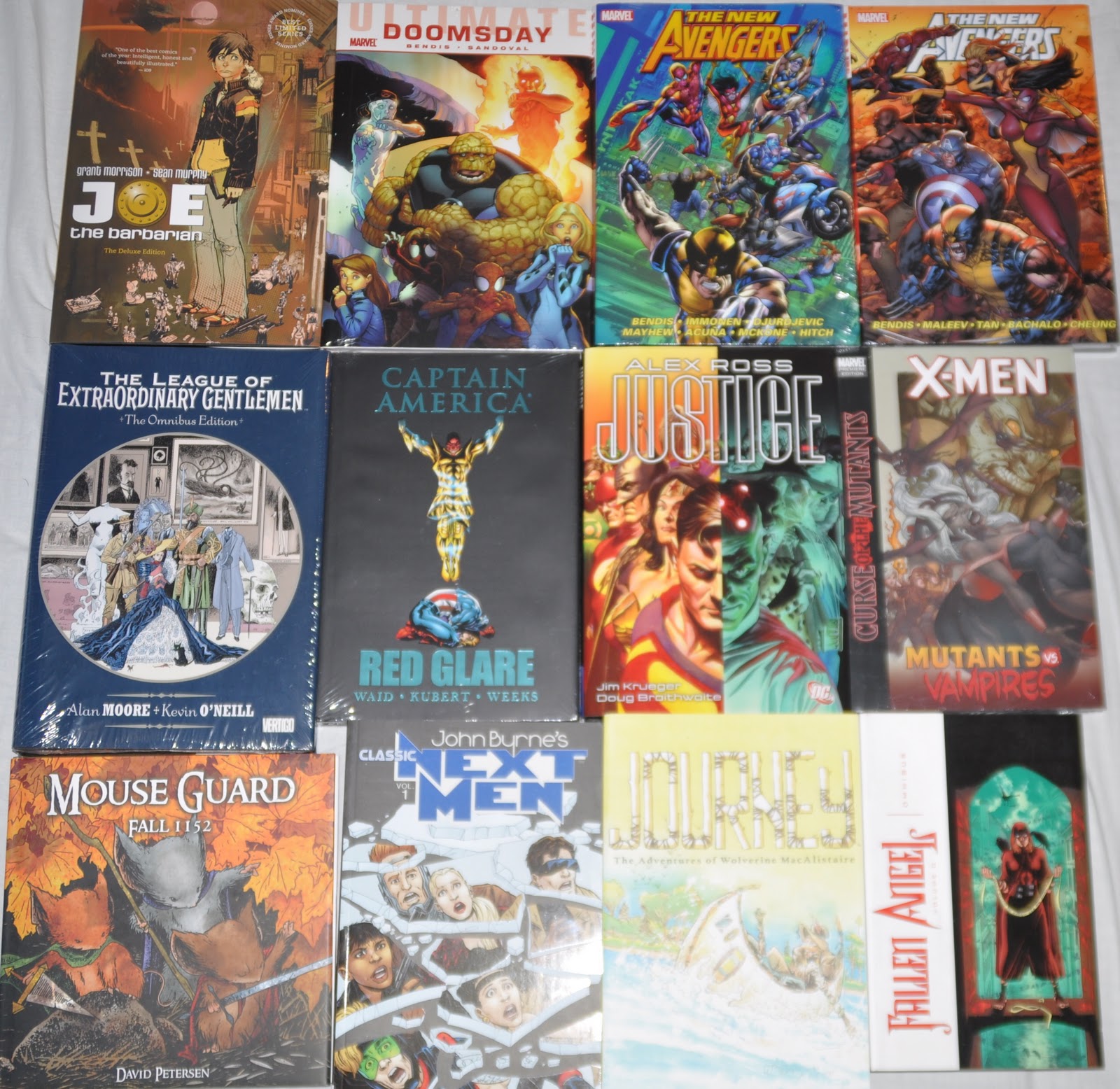
Back from the comics store, big sale edition
OK, so I don't have time to do much, or any, blogging right now with studying and work taking up a lot of my time, but I can at least buy comics that I don't have the time to read yet, either. My comics store had a sale with up to 20% off if you bought 20 comics collections, so I bought 20 comics collections.
"Journey", William Messner-Loebs' story about trapper Wolverine McAllister didn't come out all that clearly in the picture, so I'll recommend it in writing here. I'm not fond of his artwork, but the story is good.
lördag 19 november 2011
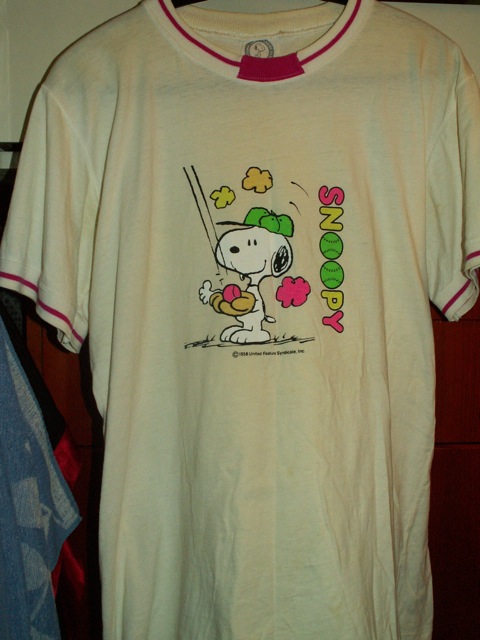
My t-shirts, part 48: Snoopy Baseball
I like this one a lot. Pleasant overall design and a great Snoopy pic. Baseball and Peanuts are inseparable in my mind.
lördag 12 november 2011
Ulf Jansson: Bengt Bouquet – Vinnörden korkar upp
Ulf Jansson is one of the best Swedish comics artists there is. He's got a strong, elegant ink line with a lot of energy and vitality to it, and an excellent sense of movement and attitude of the characters in his drawings. Working in a Franco-Belgian traditional humorous style, he'd probably be world-renowned if he'd been born in a country with more of a tradition of exporting its comics. He'd be an excellent artist for something like Spirou, for example, but as he was born in Sweden, that's unfortunately not going to happen.
So we'll have to make do with the many humor and humorous adventure strips he's created together with comics writer Magnus Knutsson, and I can live with that as they're usually quite good and worth your while, and the gag strips he's done on his own. One such was the 1979 Benke, a strip of single-page gags rather obviously inspired by Franquin's excellent Gaston but worth the read as the gags were OK and the art was excellent. It was published in the first issue of the comic book Svenska Serier, but sadly didn't come into regular production and publication.
Bengt Bouquet is a strip that wine aficionado Jansson does for the wine magazine he's an editor of, Munskänken (The Cup-bearer). It has now been collected in its first volume, Vinnörden korkar upp ("The wine nerd uncorks"), depicting the life of a somewhat fanatical wine aficionado. The jokes center on Bengt Bouquets neurotic relationship to wines, sometimes in connection with current events, and has the characteristic elegant Jansson drawings. Unfortunately, the jokes are a bit of the "inside jokes" variety – they aren't quite strong enough to stand on their own, and you probably have to be a bit of a wine nerd yourself to really enjoy them. I was a bit amused by most of them, sure, but the strip never really clicked for me.
So even though I think that any strip by Jansson deserves to be read at least once, I can't really recommend this (rather expensive, hardcover) book. Unless, of course, you are a wine aficionado yourself, and prepared to laugh a little at yourself and your hobby – or are looking for a present for somebody like that.
lördag 5 november 2011
Brad DeLong, national treasure
It's not even the politics of division, it's the politics of spite. I'll quote Prof. DeLong extensively because he's so good. His blog is well worth the at-least-daily visits it gets from me.
The Republicans are not just acting against the interests of the 99% and for the interests of the 1%. The Republicans are acting in the interests of nobody at all:
The 1% have an interest in full employment, high capacity utilization, and general prosperity just as the rest of us do.
It is true that the interests of the 1% differ from the interests of the rest of Americans in four particulars:
- The 1% have an enormous material interest in making the tax system less progressive.
- The 1% have a long-run material interest in hypnotizing Americans into believing that the current distribution of income and wealth is in some sense "deserved" or "just".
- The 1% have a short-run ideal interest in being reassured that they are in fact good people whose wealth and incomes are deserved and just.
- The 1% have a short-run material interest in not being reminded that it was the actions of many of them that played the key role in breaking the economy.
But the 1% have a strong material interest in the passage of the American Jobs Act. In acting to block it, the Republicans--and Senator Nelson--are betraying the interests of their contributors in the top 1% as much as they are betraying the interests of their constituents.
fredag 4 november 2011
Back from the comics store, not-much-time-for-anything edition
Haven't had time for much of anything other than work and studying lately, and the last week or so, work has even crowded out the studying.
But at least I've got work, so, hey... I shouldn't complain too loudly.
Anyway, some seriously cool stuff in this month's comics batch (and I have one bag of comics left to pick up because it got a bit too heavy to carry)... which only makes my lack of time to read it even more sad. Those Disney art books show just how much talent the studio has seen through the years, and I've now got the full Bloom County collection... Next up from IDW, Outland collected – which I'll get even though Outland never really clicked for me. I always thought it was the lack of a daily strip to build up, and lend stability to, the characters. The ongoing saga was weakened by the lack of a daily strip, and the ongoing saga was what gave opportunities to empathize with, and care about, the characters. With that gone, the Sundays on their own weren't enough to keep the strip really interesting for me, even though each individual Sunday page was usually pretty good.
And finally, because part of the course I'm studying involves doing a small presentation of Swedish Rococo pastel portraitist Gustaf Lundberg tomorrow, his portrait of fellow artist Charles-Joseph Natoire. Following that, a self-portrait by the French artist who replaced him as the darling of the jet-set of the day, Maurice Quentin de la Tour. Lundberg's portraits are nice and skillful, but de La Tour takes pastel portraiture to a whole new level; no wonder everybody wanted him to flatter them by making them look intelligent, handsome, and forceful in his portraits.
But at least I've got work, so, hey... I shouldn't complain too loudly.
Anyway, some seriously cool stuff in this month's comics batch (and I have one bag of comics left to pick up because it got a bit too heavy to carry)... which only makes my lack of time to read it even more sad. Those Disney art books show just how much talent the studio has seen through the years, and I've now got the full Bloom County collection... Next up from IDW, Outland collected – which I'll get even though Outland never really clicked for me. I always thought it was the lack of a daily strip to build up, and lend stability to, the characters. The ongoing saga was weakened by the lack of a daily strip, and the ongoing saga was what gave opportunities to empathize with, and care about, the characters. With that gone, the Sundays on their own weren't enough to keep the strip really interesting for me, even though each individual Sunday page was usually pretty good.
And finally, because part of the course I'm studying involves doing a small presentation of Swedish Rococo pastel portraitist Gustaf Lundberg tomorrow, his portrait of fellow artist Charles-Joseph Natoire. Following that, a self-portrait by the French artist who replaced him as the darling of the jet-set of the day, Maurice Quentin de la Tour. Lundberg's portraits are nice and skillful, but de La Tour takes pastel portraiture to a whole new level; no wonder everybody wanted him to flatter them by making them look intelligent, handsome, and forceful in his portraits.
![]() |
| Natoire by Lundberg. |
![]() |
| de La Tour by himself. |
Prenumerera på:
Inlägg (Atom)